<!-- PINTEREST HERO IMAGE: Vertical 1000x1500 image of a bright, airy living room mid-transformation — one side showing a cluttered corner with boxes, the other side styled and minimal with a cozy armchair, plant, and folded throw; bold overlay text "DECLUTTER ROOM BY ROOM" in clean white serif font on a warm terracotta banner -->
# Declutter Room by Room: The Complete Guide
Trying to declutter your entire home at once is the fastest way to give up by lunch. The rooms blur together, the piles grow faster than you can sort them, and by the end of the day the house looks worse than when you started. There's a better way: go room by room, with a clear system, in a sensible order, and give every space a finish line.
This guide walks you through the whole home — where to start, how to decide what stays and what goes, and a specific checklist for each room. Follow it once through and you'll have a home that stays clutter-free, because you'll have built the decision-making habits that keep it that way.
> *Affiliate disclosure: Roomora is reader-supported. When you buy through links on this page, we may earn an affiliate commission at no extra cost to you.*
Why room by room beats whole-house blitzes
Decluttering fails most often because of scope creep. You start in the bedroom, find a box of old cables, carry it to the office, notice the desk drawer is a mess, start on that, find birthday cards to file... three hours later five rooms are half-torn-apart and nothing is done.
The room-by-room method fixes this with two rules:
- Finish one room before starting the next. A finished room is a win you can see and live in. Five finished rooms, one at a time, is a transformed home. Five rooms started at once is a disaster.
- Everything you touch gets a decision. Pick it up, decide: keep, toss, donate, relocate. No "maybe" piles. Maybes are just delayed decisions that become permanent clutter.
There's a third, less obvious reason this works: momentum. Decluttering gets faster as you go because your decision muscles get stronger. By room four, you're deciding in seconds what took you minutes in room one.
The universal declutter system (use in every room)
Before touching room one, set up your sorting station. You need four containers — bags, boxes, or laundry baskets all work:
- Keep — stays in this room, in its right home
- Relocate — belongs in another room (don't carry it there yet; deal with these at the end)
- Donate/Sell — good condition, someone else can use it
- Toss/Recycle — broken, expired, stained, genuinely useless
Work in this order in every room: trash sweep first, then obvious donations, then the keepers, then relocate. The trash sweep is the easy win — expired items, broken things, obvious junk. You'll fill a bag in twenty minutes and the room already looks better, which fuels the harder decisions ahead.
The keep-toss-donate test for anything you're unsure about: "Would I buy this again today at full price?" If the answer is no, you don't need it. A second test: "If I moved next month, would I pay to pack and move this?" Decluttering and moving use the same honesty.
Set a time limit per room — two to four hours depending on room size. Decluttering has diminishing returns; decision fatigue sets in around hour three and you start keeping everything out of exhaustion. A timer keeps you honest.
Where to start: the room order that builds momentum
Not all rooms are equal. Start where you'll see results fastest and where decisions are easiest:
- Bathroom — small, decisions are easy (expired = toss), visible win fast
- Entryway — small, high daily impact, quick win
- Kitchen — big win, medium difficulty
- Bedroom + closet — personal, take your time
- Living room — mostly surfaces and storage
- Kids' rooms — involve the kids, different rules
- Laundry room / utility areas — functional spaces
- Garage / basement — hardest, do last when your decision muscles are strongest
- Home office — paper-heavy, needs its own session
This order isn't random. The bathroom takes an hour and transforms completely — that early win powers you through the kitchen. The garage goes last because it's where the genuinely hard decisions live (sentimental items, expensive-but-unused things), and by then you're a decluttering veteran.
Room-by-room checklists
The bathroom (1 hour)
Bathrooms accumulate expired products and duplicates faster than any room in the house. Be ruthless here — nobody needs four half-used bottles of the same shampoo.
- Empty the medicine cabinet and drawers completely; wipe them down
- Toss anything expired: medications, sunscreen, makeup over a year old, dried-out products
- Consolidate duplicates: one open shampoo at a time, backstock goes in a single bin
- Keep only what you use weekly on the counter; everything else goes behind doors
- Test every "someday" product — if you haven't used it in six months, donate or toss it
- Corral the keepers: a small tray for daily items, drawer dividers for the rest
Pair this with our guide to small bathroom storage ideas once the clutter is gone — the right storage only works on a decluttered base. The same goes for bathroom vanity organization and under-sink organization, which are much easier projects after this reset.
The entryway (45 minutes)
The entryway is your home's first impression and its clutter magnet. Everything without a home lands here.
- Remove everything that doesn't belong: mail goes to its spot, bags go to closets, random items get relocated
- The shoe rule: one pair per person by the door, the rest live in a closet
- Hooks for each person: one hook for the daily bag, one for the daily jacket — no more
- A small tray or bowl for keys, sunglasses, and the wallet; nothing else lives on that surface
- Paper triage: mail gets sorted on arrival — recycle, file, or action. No "entryway filing system"
- Seasonal swap: out-of-season coats, boots, and gear leave the entryway immediately
Our entryway organization ideas guide takes it from here with systems that keep this space clear permanently.
The kitchen (3-4 hours)
The kitchen is where decluttering pays the biggest daily dividends. Every duplicate gadget and mystery container you remove makes cooking noticeably easier.
- Cabinets: empty one cabinet at a time. Toss chipped mugs, warped plastic, anything missing its lid. Keep the pieces you actually use weekly — most households need 8-10 plates, not 30
- Gadgets: the single-use rule — if it does one job a knife or pan could do, it goes. Keep only gadgets you used in the last month
- Pantry: toss expired everything, consolidate half-empty duplicates, decant staples
- Drawers: the junk drawer gets emptied completely and reborn as a useful drawer — or it's allowed to be a junk drawer, but a small, contained one
- Countertops: the goal is clear counters. Appliances you don't use weekly get stored. Keep out only the daily crew: coffee maker, maybe a knife block
- Fridge and freezer: toss expired condiments (check dates — most are years old), freezer-burned mystery bags, and anything you can't identify
For the deeper systems, see kitchen cabinet organization ideas and pantry organization ideas. Small kitchens get their own playbook in small kitchen organization ideas.
The bedroom (2-3 hours)
Bedrooms should be restful. Clutter on every surface fights sleep — you can't fully relax in a room that's visually noisy.
- Surfaces first: nightstands, dresser tops, and any "chairdrobe" get cleared. Nightstand keeps: lamp, book, water, charger. That's it
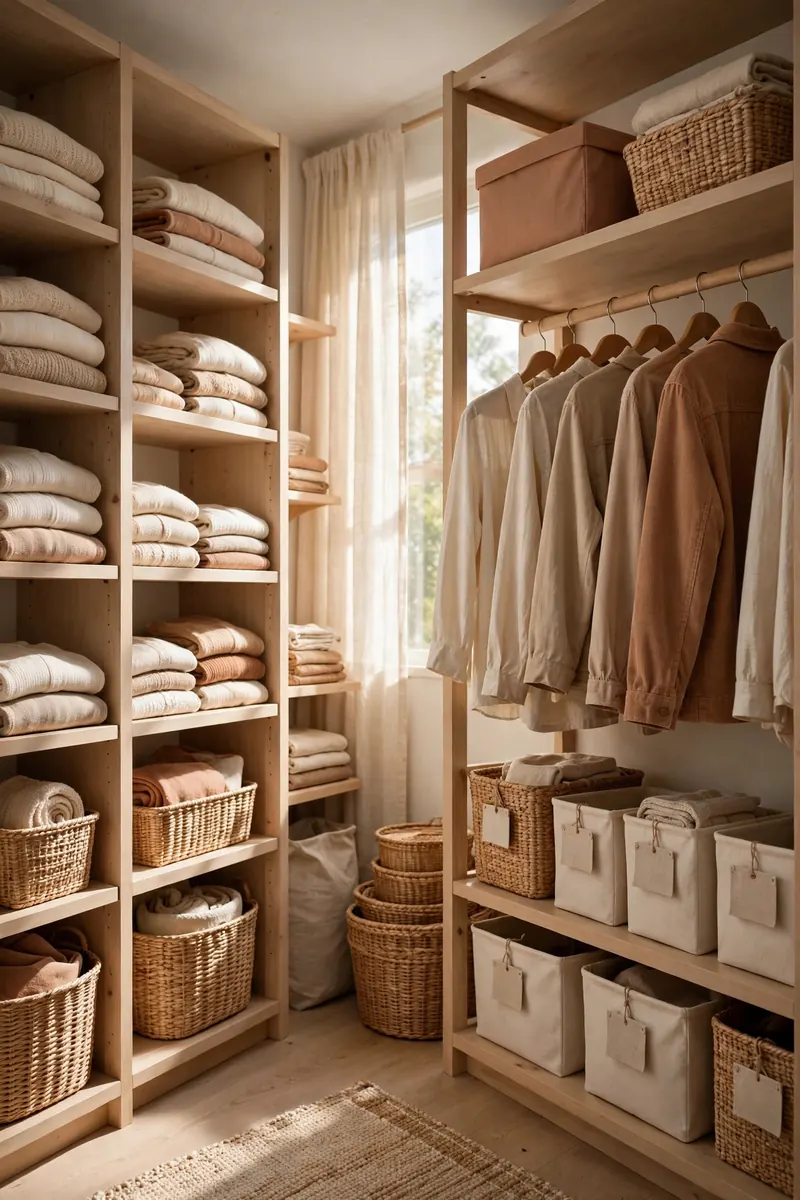
- Closet: the hanger trick in reverse — pull everything out, and only put back what fits, flatters, and you've worn in the last year. Everything else: donate
- Under the bed: this is storage, not a hiding place. If it's full of things you never use, those things don't need storing — they need leaving. Our under-bed storage ideas show what actually belongs down there
- Drawers: fold or roll everything so you can see it all. If a drawer is stuffed, you own too much for the drawer — remove, don't buy a bigger dresser
- Sentimental items: set these aside for a dedicated session, not mid-bedroom-declutter. They deserve their own time and they derail everything
Small bedrooms need extra discipline — small bedroom ideas and small closet organization ideas cover maximizing what you keep. Walk-in owners, see bedroom closet ideas walk-in.
The living room (2 hours)
Living rooms collect other rooms' clutter: kids' toys, mail, chargers, hobby supplies. The fix is giving everything a real home elsewhere.
- Clear every surface completely, then put back only what belongs: decor, remotes in a tray, current book or magazine
- Media: consolidate remotes, recycle old cables, donate DVDs and games nobody touches
- Books and magazines: keep what you'll reread or reference. Recycle the magazine stack
- Toy triage: living room gets one basket of toys max — the rest live in kids' rooms. See toy storage ideas for systems that contain the sprawl
- Cords and chargers: one charging station, everything else goes
- Furniture check: is every piece earning its space? The chair nobody sits in is just a horizontal surface for clutter
For styling the newly clear space on a budget, living room decor ideas on a budget is your next read.
Kids' rooms (2 hours, with the kids)
Don't declutter kids' rooms secretly — it breeds distrust and they'll just re-clutter defensively. Do it together with clear, kind rules.
- The toy test: if they can't name it or haven't played with it in months, it goes in the donate box. Let them choose some donations themselves — it builds generosity
- Broken rule: broken toys leave immediately, no "we'll fix it" pile
- One-in-one-out: going forward, a new toy means choosing one to donate. Make this the house rule
- Categories: group what remains — building toys, art supplies, dolls/figures, games. Each category gets one container
- Artwork: keep favorites in a portfolio or photograph them and let the paper go. Kids produce art faster than any home can store it
Our kids room organization ideas guide builds the storage systems to match.
Laundry room (1 hour)
Laundry rooms become storage for everything that doesn't fit elsewhere. Reclaim it.
- Toss dried-out detergent bottles, single socks (the mate is never coming back), and cleaning products you don't use
- One of each cleaning product, not three half-bottles of the same thing
- Lost-and-found bin: one small bin, emptied monthly — not a permanent laundry room resident
- Keep only laundry supplies and cleaning tools here; relocate everything else
See laundry room organization ideas for the storage side.
Garage and basement (4-6 hours, do last)
These are the final boss. Everything avoided in earlier rooms ended up here, plus years of "just in case" storage.
- Zones first: decide what the space is for — parking, workshop, storage, gym — and clear anything that doesn't serve those purposes
- The 12-month rule is strictest here: unused in a year, out it goes. "Just in case" is how garages become unusable
- Tools: keep what you use; duplicates and broken tools go
- Holiday decor: keep what you actually display. The box of tangled lights from 2019 goes. Our holiday decor storage ideas show how to store what you keep properly
- Paint and chemicals: dispose of properly (most municipalities have hazardous waste days) — don't just trash them
- Go vertical: what stays goes up — wall hooks, ceiling racks, shelving. Floor space is for cars and walking
Deep dives: garage organization ideas and basement storage organization ideas.
Home office (2 hours)
Paper is the main enemy here, plus tech clutter.
- Paper triage: recycle, shred, file, action — four piles, no fifth option. Most paper can be recycled; scan anything you might need
- Tech drawer: one drawer for cables and gadgets. Test cables; toss the mystery ones. Old phones and laptops get wiped and recycled or donated
- Desk surface: monitor, keyboard, lamp, one notebook. Everything else lives in drawers
- Supplies: one pen cup, not five. Consolidate office supplies into one organizer
- Files: if you haven't opened a paper file in a year, scan it or shred it
See home office small spaces for making the cleared space work harder.
The 15 hardest things to declutter (and how to handle them)
Some categories resist every system. Here's how to think about each:
- Sentimental items — keep a curated few, photograph the rest. A memory box with a size limit (one box per person) forces curation
- Gifts you dislike — the gift already served its purpose when given. Donate guilt-free
- Expensive mistakes — the money is gone whether you keep the item or not. Keeping it just adds clutter guilt
- "Just in case" items — if it's replaceable for under $20 in under 20 minutes, you don't need to store it
- Kids' artwork — photograph, keep a portfolio of favorites, recycle the rest
- Clothes that don't fit — keep one "goal" outfit max. The rest goes
- Books — keep reference books and rereads. Fiction you've finished can find new readers
- Hobby supplies — if you haven't touched the hobby in a year, the supplies are clutter
- Duplicates — you need one good one, not three mediocre ones
- Paperwork — scan and shred. Digital copies are legally fine for almost everything personal
- Cables and chargers — test them now. Mystery cables go
- Travel souvenirs — one shelf of curated favorites beats three boxes of "stuff from trips"
- Inherited items — keep what you love and would choose yourself. Love isn't inherited with the object
- Craft supplies — one project at a time. The stash for six future projects is a store, not a hobby
- Anything you're keeping for someone else — give it to them or set a pickup deadline. After the deadline, it's yours to decide
Keeping it clutter-free: the maintenance system
Decluttering once is an event. Staying clutter-free is a system. Build these five habits:
- One in, one out — the single most powerful rule. New shirt in, old shirt out. It makes every purchase a conscious trade
- The 10-minute nightly reset — set a timer, whole family, put everything back. Ten minutes nightly beats a Saturday marathon
- Weekly donation bag — keep a bag by the door. When it's full, drop it off. Constant low-effort outflow
- The 30-day list — want something non-essential? Write it down, wait 30 days. Most desires expire
- Seasonal mini-declutters — 30 minutes per room each season catches drift before it becomes clutter
A weekly cleaning schedule pairs perfectly with the nightly reset — cleaning and decluttering maintain each other.
Frequently asked questions
How long does it take to declutter a whole house?
For an average home, plan one full weekend for the main rooms plus a second weekend for garage, basement, and office — roughly 20-30 hours total spread across sessions. Don't try to do it in one day; decision fatigue will wreck your judgment by afternoon. Two to three focused sessions per week for a month is the most sustainable pace.
What should I declutter first?
Start with the bathroom — it's small, decisions are easy (expired means toss), and you get a complete visible win in about an hour. That momentum carries you into bigger rooms. Save the garage, basement, and sentimental items for last, when your decision-making is sharpest.
How do I declutter without making a bigger mess?
Work one room at a time and never start a second room until the first is finished. Use the four-container system (keep, relocate, donate, toss) so everything you touch gets an immediate decision. Process the relocate box at the end of each room — carry those items to their rooms before starting the next one.
What do I do with sentimental clutter?
Give sentimental items their own dedicated session, separate from room decluttering — they need different energy and they derail practical sessions. Set a size limit (one memory box per person), keep the best representatives of each memory, and photograph the rest before letting go. The memory lives in you, not the object.
Should I sell or donate my decluttered items?
Donate anything worth less than about $50 unless you genuinely enjoy selling — the time cost of listing, messaging, and meeting buyers usually exceeds the return. Sell only higher-value items in good condition, and give yourself a two-week deadline: whatever hasn't sold gets donated. A box of "to sell" items sitting for months is just clutter with extra steps.
How do I get my family on board with decluttering?
Don't declutter other people's belongings without them — it breeds resentment and they'll re-clutter defensively. Start with shared spaces and your own things; visible results are persuasive. For kids, make it collaborative with clear rules (broken goes, one-in-one-out going forward). For partners, agree on shared-space standards and let personal spaces be personal.
Pin title ideas
- Declutter Room by Room: The Complete Whole-Home Guide
- The Room-by-Room Declutter Order That Actually Works
- 15 Hardest Things to Declutter (and How to Let Go)
- Whole House Declutter Checklist: Every Room Covered
- 5 Habits That Keep Your Home Clutter-Free Forever
Keep going
Decluttering is the foundation — organization is the structure you build on it. Next up: pantry organization ideas to systematize the kitchen you just cleared, and linen closet organization ideas for the linens you decided to keep.
Get the Sunday reset: one practical home idea in your inbox every week — subscribe free here. No spam, ever.