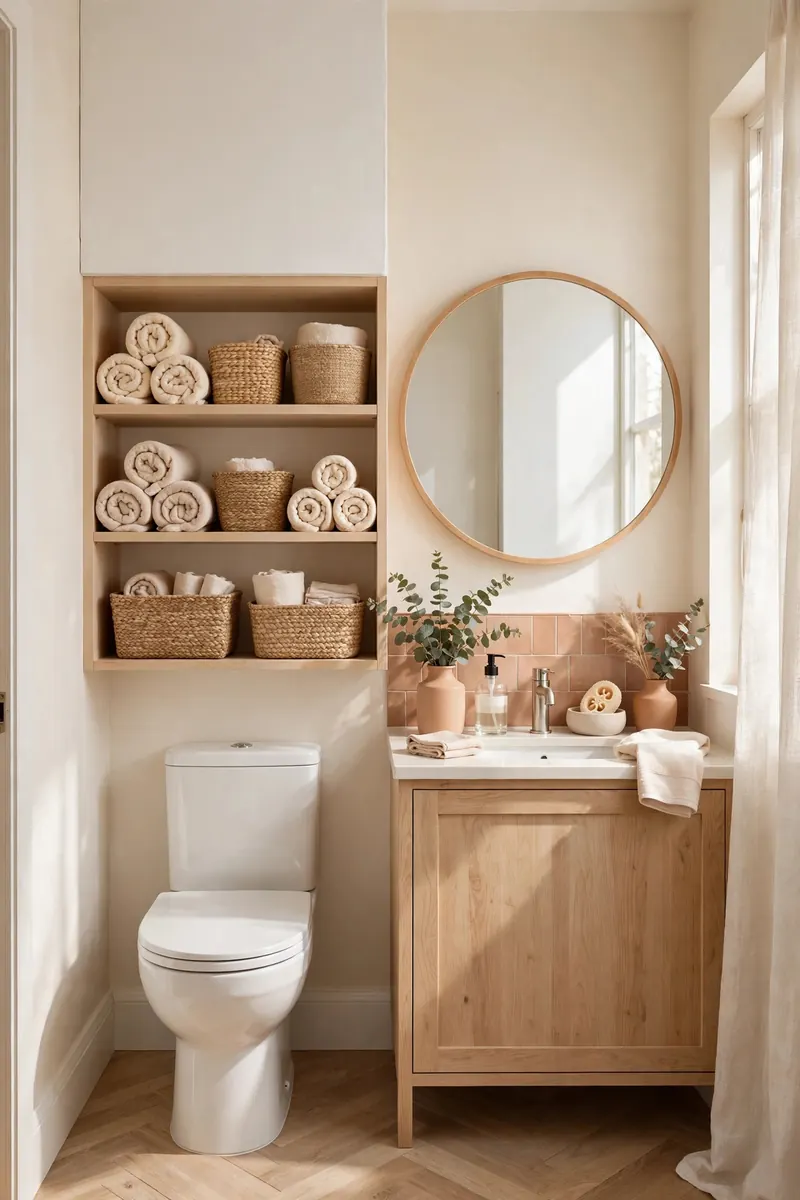
The vanity chaos problem
The bathroom vanity is the hardest-working storage in the house and the worst-organized. It's where two people's morning routines collide: toothpaste, skincare, medicines, hair tools, cleaning supplies, and the mysterious half-empty bottles nobody admits to owning. Everything gets shoved into drawers that jam, cabinets nobody can reach into, and a countertop that somehow holds nothing and everything at once.
The vanity's problem isn't really space — it's systems. Most vanities have enough room; they just have no logic. Drawers become junk drawers, under-sink cabinets become dead zones behind pipes, and countertops collect everything that doesn't have a home. A morning routine that should take fifteen minutes takes twenty-five because you're digging for the moisturizer that's behind the hairspray that's under the contact lens case.
These seventeen ideas fix the three vanity zones — drawers, under-sink cabinet, and countertop — plus the medicine cabinet most people forget they have. No renovations required. Everything here works in rentals too.
Vanity drawers: the morning command center
Drawers are where the daily routine lives. They should be the fastest, most accessible storage in the bathroom.
1. Start by emptying every drawer completely
Pull everything out onto a towel. You'll find expired sunscreen, hotel shampoo from 2022, three lip balms, and products you bought twice because you couldn't find the first one. Toss anything expired, dried out, or separated — cosmetics have real shelf lives (mascara 3 months, sunscreen 1 year, most skincare 12 months once opened). Keep only what you actually use weekly. Most vanity chaos is volume, not organization.
2. Add drawer dividers before anything goes back
Dividers are the single highest-impact drawer upgrade. Without them, everything migrates into a pile within a week. Spring-loaded dividers work in any drawer; custom-fit bamboo trays feel more permanent. Assign every category a home: skincare in one section, dental in another, hair products in a third. The rule is simple — every item has a defined zone, and anything without a zone doesn't go back in.
3. Stand bottles upright in deep drawers
Deep vanity drawers waste their vertical space when bottles lie flat. Use small drawer inserts or cut-down boxes to create upright slots for taller bottles — serums, toners, contact solution. Upright bottles are visible, reachable, and take up less footprint than lying-down bottles rolling around. For US and UK readers: those cheap plastic drawer organizers from the pound shop or dollar store work perfectly here — no need for fancy systems.
4. Give the top drawer the "daily six" treatment
The top drawer should hold only what you touch every single day — your daily six or so items. Everything else moves down. This is the drawer you open half-asleep at 6 AM; it should require zero searching. Toothbrush, toothpaste, deodorant, moisturizer, medication, contacts — whatever your actual daily set is. If you reach past something every morning, it doesn't belong in the top drawer.
5. Corral the small stuff in lidded containers
Bobby pins, hair ties, cotton buds, tweezers, nail clippers — the tiny items that vanish into drawer corners. Small lidded containers or magnetic tins keep them findable. Clear containers beat opaque ones: if you can't see it, you'll forget you own it and buy another. This is where most duplicate purchases come from.
Under-sink vanity cabinet: taming the dead zone
The cabinet under the vanity sink has the same pipe problem as the kitchen — awkward, dark, and half-unreachable. Different contents, same fix.
6. Install a pull-out organizer around the plumbing
A U-shaped or two-piece pull-out organizer fits around the drain pipe and brings the back of the cabinet to you. This is where backstock lives: extra toilet paper, backup shampoo, cleaning supplies, the first-aid kit. Sliding organizers turn dead space into usable storage. Measure around your pipes first — every vanity's plumbing layout is slightly different, and an organizer that's an inch too tall is useless.
7. Mount organizers on the cabinet doors
The inside of under-sink doors is free real estate. Slim adhesive caddies or over-door wire racks hold hair dryers (unplugged and cool), cleaning spray bottles, and spare sponges. Keep it lightweight — heavy bottles stress cabinet hinges over time. Door storage is ideal for tall, awkward items that don't fit in drawers.
8. Use stackable bins for category zones
Under-sink space works best as labeled zones: "cleaning," "backstock," "hair tools," "first aid." Stackable bins with handles let you pull a whole category out at once instead of reaching past pipes. Label the bins broadly enough to survive product changes — "skincare backstock" outlasts any specific brand.
9. Add a waterproof mat under everything
Bathroom vanities leak — slow drips from supply lines, condensation, the occasional knocked-over bottle. A waterproof mat with a raised lip protects the cabinet floor and makes cleanup a wipe instead of a repair. Check under it every few months; mats can hide slow leaks as well as contain them.
Countertop: the visible zone
Countertop clutter is what makes a bathroom feel messy even when the drawers are perfect. The countertop needs rules, not just organizers.
10. Follow the "daily touch" rule
Only items you touch every single day earn countertop space. Everything else goes in a drawer or cabinet. This one rule eliminates 70% of countertop clutter. Be honest: that decorative tray of twelve products you haven't touched in a month is storage, not display. Move it.
11. Use a single tray to contain the survivors
The daily items that survive the cut live on one tray — not scattered across the counter. A tray creates a visual boundary: everything on the tray belongs, everything off it doesn't. It also makes cleaning the counter a one-lift job instead of moving twelve bottles individually. Choose a tray with a lip so nothing slides off.
12. Mount what you can on the wall
Toothbrush holders, soap dispensers, and small shelves mounted on the wall or mirror free counter space permanently. A wall-mounted dispenser for hand soap eliminates one more bottle. Magnetic strips inside the medicine cabinet hold tweezers and nail clippers. Every item that moves off the counter is one less thing to clean around.
13. Decant the ugly, keep the pretty
Bulky product packaging is visual clutter. Decant hand soap, mouthwash, and cotton balls into simple matching dispensers and jars. You don't need a full apothecary aesthetic — just reducing five clashing labels to two neutral containers makes the counter feel calmer. Keep original labels for anything with safety warnings or expiry dates.
Medicine cabinet: the forgotten storage
If your vanity has a mirrored medicine cabinet, it's probably underused. It's the best storage in the bathroom — eye-level, shallow (so nothing gets lost in back), and right where you need things.
14. Reorganize the medicine cabinet by frequency
Top shelf: rarely used (spare contacts, backup meds). Middle shelves at eye level: daily items (prescriptions, vitamins, deodorant). Bottom: things you grab in a hurry. Most people do the opposite — daily stuff crammed wherever it fit first. Fifteen minutes of re-sorting by frequency saves seconds every single morning, which adds up.
15. Add small risers for double-decker storage
Medicine cabinet shelves are usually tall enough for two rows if you add a small riser or mini shelf insert. Short items (lip balm, pill organizers) go on the riser; taller bottles stand behind them. This doubles the usable shelf count without any installation. Adhesive-backed risers work in rentals.
16. Check expiry dates while you're in there
Medicines expire. Sunscreen expires. Eye drops expire faster than you'd think (usually 28 days once opened — check the label). While reorganizing, toss anything past its date. Expired medicine isn't just ineffective — some formulations degrade into irritants. Set a twice-yearly reminder; tie it to daylight saving clock changes so you remember.
Keep it organized
17. Do a five-minute weekly reset
Vanity organization fails without maintenance, but maintenance doesn't need to be a project. Once a week — Sunday night works — spend five minutes: wipe the counter, toss empties, put migrated items back in their zones, check for anything leaking. Five minutes weekly beats a two-hour reorganization every six months. The system only works if the zones stay honest.
More ideas you'll love
Frequently asked questions
How do I organize a small bathroom vanity with no drawers?
Use the under-sink cabinet with a pull-out organizer, mount caddies on the doors, and add a small rolling cart beside the vanity for daily items. A wall-mounted shelf above the toilet adds storage without touching the vanity. The key is distributing storage across zones instead of cramming everything under the sink.
What's the best way to organize deep vanity drawers?
Drawer dividers first — spring-loaded or bamboo trays. Stand bottles upright using small inserts, put daily items in the top drawer only, and corral tiny items (bobby pins, tweezers) in small lidded containers. Deep drawers fail when items lie flat and migrate; vertical storage and zones fix both.
How do I keep my bathroom countertop clutter-free?
The "daily touch" rule: only items you use every single day stay on the counter. Everything else goes in drawers or cabinets. Contain survivors on a single tray, mount soap dispensers and toothbrush holders on the wall, and decant bulky packaging into simple containers.
Should I store medicines in the bathroom?
The bathroom's heat and humidity actually degrade many medications faster — pharmacists generally recommend a cool, dry spot like a bedroom drawer or kitchen cabinet instead. If you do keep daily meds in the vanity, use the medicine cabinet (less humid than under-sink) and check expiry dates twice a year.
How often should I declutter my bathroom vanity?
A five-minute weekly reset (wipe, toss empties, re-zone) plus a full declutter every 3–4 months. Cosmetics expire — mascara lasts about 3 months, sunscreen about a year, most opened skincare about 12 months. The quarterly check catches expired products before they cause skin problems.
What if two people share one vanity?
Split by side or by drawer — each person gets defined zones. Shared items (hand soap, cleaning supplies) go in neutral zones. His-and-hers drawer dividers in different colors prevent the slow migration where one person's stuff colonizes everything. Under-sink storage splits well by bin: one bin per person plus one shared.
Keep going
Vanity order connects to the whole bathroom — the same zone logic works for small bathroom storage and under-sink cabinets throughout the house.
Get the Sunday reset: one practical home idea in your inbox every week — subscribe free here. No spam, ever.