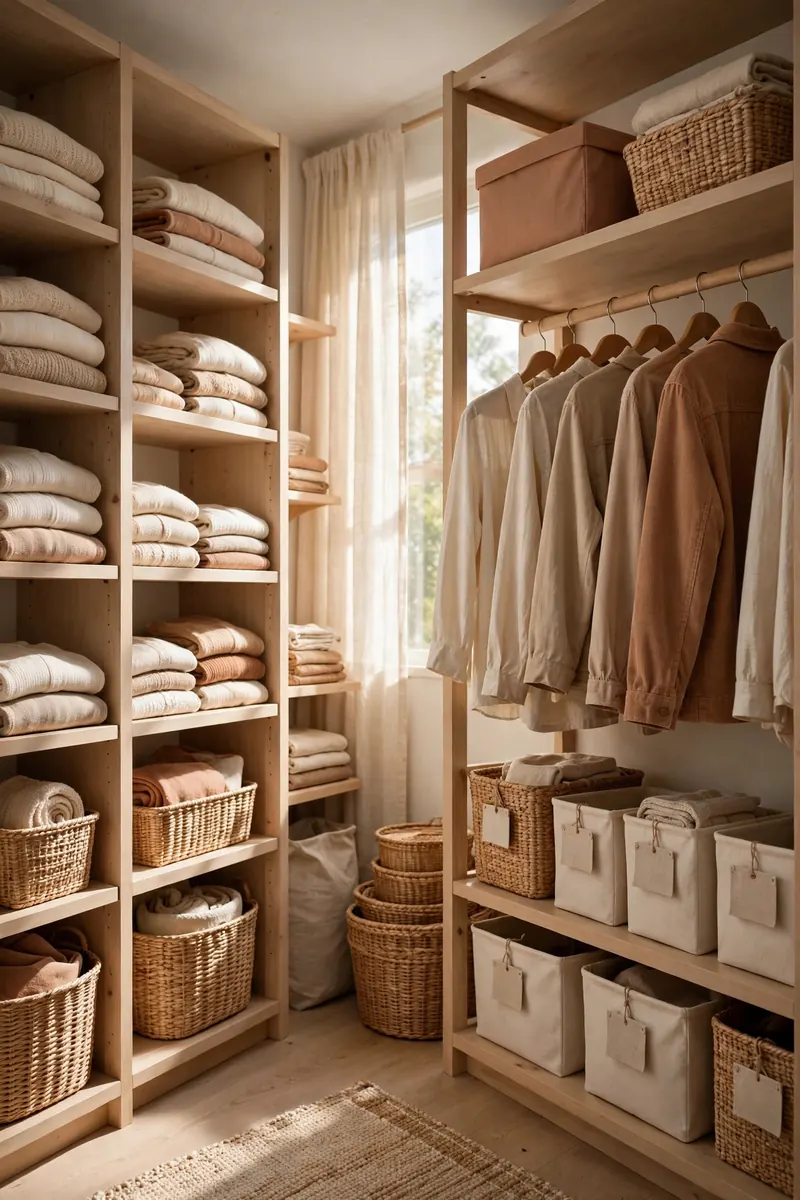
The small closet problem
Most reach-in closets waste half their space. There's a single rod, one shelf, and a floor — and everything gets crammed onto the rod while the vertical space above and below sits empty. The result is a closet that's technically full but functionally useless: you can't find anything, half your clothes are wrinkled, and getting dressed feels like archaeology.
Doubling a small closet's storage doesn't require a renovation. It requires using the space you already have — the air above the rod, the floor below, the back of the door, and the walls on either side. These twenty ideas are organized from highest impact to finishing touches, and most cost under $30.
Start with a ruthless reset
No organizer fixes a closet stuffed with things you don't wear. Before buying anything, do the reset.
1. Empty the entire closet
Take everything out. Every hanger, every shoe, every box on the top shelf. You can't organize what you can't see, and closets hide their true volume — most people are shocked by how much is in there. Work in one session if possible; a half-emptied closet has a way of staying half-emptied for weeks.
2. Try the hanger test
Turn all your hangers backward on the rod. Every time you wear something, hang it back facing forward. After three months, anything still backward hasn't been worn — and probably won't be. This is the most honest closet audit there is because it tracks your actual behavior, not your intentions.
For folded items and shoes, use a simpler rule: if you haven't reached for it in a full year and it isn't seasonal or occasion-specific (a suit, a formal dress), it goes.
3. Sort into four piles: keep, donate, relocate, trash
Keep means it fits, you wear it, and it belongs in this closet. Donate means someone else would wear it — bag it and get it out of the house within 48 hours, or it migrates back. Relocate means it belongs somewhere else (coats to the entryway closet, gym bag to the laundry area, off-season to storage). Trash means stained, broken, or stretched beyond rescue. Be honest about the donate pile: "maybe I'll fit into it again" is how closets refill.
Double your hanging space
Hanging space is the scarcest resource in a small closet. These ideas multiply it.
4. Install a double-hang rod
A second rod below the first instantly doubles hanging capacity for shirts, blouses, and folded pants. Most reach-in closets have a single rod at about 66 inches — there's easily room for a second rod at 40 inches for tops and a lower section for pants or skirts. Tension-style double rods need no drilling and work in rentals; a closet rod extender that hangs from the existing rod costs even less and installs in seconds.
Measure first: you need roughly 40 inches of vertical clearance for shirts and 34 for folded pants. If your closet is short, use the double rod on one half only and leave the other half full-length for dresses and coats.
5. Switch to slim velvet hangers
Bulky plastic and wooden hangers eat inches. Slim velvet hangers are about a quarter-inch thick versus over an inch for plastic — across 50 hangers, that's roughly 30 inches of rod space reclaimed. The velvet surface also grips clothes so nothing slides off. Replace hangers gradually if budget is tight; start with your bulkiest section.
6. Use cascading hanger hooks
Cascading hooks let one hanger hold five, hanging vertically instead of side by side. They're ideal for grouping outfits, organizing by color, or storing a week's work clothes in the space of one hanger width. They work best for lightweight items — don't cascade heavy coats or you'll bend the top hanger.
7. Add a hanging shelf organizer
A fabric hanging organizer (the kind with 5-6 cubbies) turns dead rod space into folded storage for sweaters, jeans, t-shirts, and bags. Hang it at one end of the rod where it won't block your most-reached-for clothes. Sweaters especially belong here rather than on hangers, where they stretch out of shape.
Go vertical: walls, doors, and air
The average reach-in closet has 2-3 feet of unused vertical space. Claim it.
8. Mount an over-the-door organizer
The back of the closet door holds shoes, accessories, scarves, belts, or handbags — a full extra storage zone that costs zero closet space. Choose a slim organizer so the door still closes; measure your door clearance before buying. Clear-pocket versions beat fabric ones for visibility: if you can't see it, you won't use it.
9. Bin the top shelf properly
The top shelf is where closets go to die — a graveyard of stacked, toppling piles. Fix it with labeled bins or baskets, one category per bin: off-season accessories, handbags, hats, travel gear. Bins turn an avalanche-prone shelf into pull-down-and-grab storage. Label every bin; unlabeled bins become mystery boxes within a month.
10. Add hooks to the side walls
The narrow side walls inside a reach-in closet are perfect for hooks: tomorrow's outfit, a robe, belts, bags, or a jewelry organizer. Adhesive hooks work in rentals and hold surprising weight — use two hooks side by side for heavier bags. This is five-minute, near-free storage.
11. Stack shoes vertically, not on the floor
Shoes scattered on the closet floor waste the entire footprint. A narrow stackable shoe rack, an over-door shoe organizer, or even a simple tension rod near the floor for heeled shoes lifts them into vertical space. Keep only in-season, frequently-worn shoes in the closet; the rest go to under-bed storage or a hall closet.
The floor is storage too
Once hanging and vertical space are handled, the floor becomes bonus storage instead of a shoe graveyard.
12. Slide rolling bins underneath
Low rolling bins under hanging clothes hold off-season items, extra linens, or rarely-worn shoes. Because they roll, you can actually reach what's inside — unlike static boxes shoved into the dark. Clear bins win again for visibility; if you use opaque ones, label the front face.
13. Use a small dresser or cube unit inside
If your closet is wide enough, a small 3-drawer unit or cube shelf on the floor replaces a bedroom dresser entirely — which frees bedroom floor space too. This is the single biggest small-bedroom win: move folded clothes into the closet and reclaim an entire piece of furniture's worth of room.
14. Corral with baskets, not piles
Baskets on the closet floor for laundry, accessories, or "to mend" items keep the floor from becoming a pile zone. One basket per category, and the rule is simple: it goes in the basket or it doesn't go on the floor.
Budget solutions that actually work
You don't need a custom closet system. These cost little and deliver a lot.
15. Tension rods as dividers and extra bars
A second tension rod mounted vertically or horizontally creates a shoe rack (heels hook over it), a scarf organizer, or a divider for stacked items. Tension rods cost a few dollars, install in seconds, and leave no marks — the renter's secret weapon.
16. Dollar-store bins with a label maker
Matching bins look custom; they don't need to be expensive. Inexpensive bins in one color with clean labels look intentional and work identically to premium ones. Spend the savings on the label maker — labels are what keep any system alive past week two.
17. DIY shelf dividers from bookends or acrylic
Closet shelves become messy because stacked items have no boundaries. Shelf dividers — or even simple bookends — keep stacks of jeans, sweaters, and t-shirts upright and separated. One divider per stack, and the leaning-tower-of-sweaters problem disappears.
Seasonal rotation: the multiplier
This is the idea that makes a small closet feel twice as big, because it effectively is — you're only storing half your wardrobe at a time.
18. Store off-season clothes elsewhere
Heavy coats, boots, and sweaters don't belong in your closet in July; shorts and sandals don't belong in January. Vacuum-seal bags compress off-season clothes to a fraction of their size and slide under the bed or onto a high shelf. The seasonal swap takes an hour twice a year and instantly frees 30-40% of your closet.
19. Keep a "maybe" box with a date
For items you're not sure about, box them, date the box, and store it out of the closet. If you don't open it in six months, donate the whole box unopened. This breaks the "but I might wear it" deadlock without forcing painful decisions in the moment.
20. Do a 15-minute monthly reset
Systems drift. Once a month, spend fifteen minutes: rehang anything on the floor, return relocated items, and pull one thing to donate. Small, regular corrections beat annual overhauls — and the closet never reaches crisis state again.
More ideas you'll love
Frequently asked questions
How can I double hanging space in a small reach-in closet?
Install a double-hang rod: a second rod below the existing one for shirts and folded pants. Combined with slim velvet hangers (which reclaim inches across a full rod), most closets genuinely double their hanging capacity for under $30.
What's the best renter-friendly closet organization?
Tension-rod double hangers, over-the-door organizers, adhesive wall hooks, freestanding shoe racks, and rolling under-hanging bins — all removable with no holes. Avoid anything that requires drilling into the landlord's shelving or walls.
How do I organize a closet with no shelves?
Create shelves: a hanging fabric organizer on the rod gives you 5-6 cubbies instantly, a small cube unit or 3-drawer dresser on the floor adds folded storage, and over-door organizers handle shoes and accessories. No built-in shelving required.
Should I store off-season clothes in my small closet?
Only if you have no alternative. Moving off-season items to under-bed storage or vacuum bags elsewhere typically frees 30-40% of closet space — the single biggest capacity gain after double-hanging. Do the seasonal swap twice a year.
How do I keep a small closet from getting messy again?
Three habits: the 15-minute monthly reset, one-in-one-out for new purchases, and labels on every bin. Systems fail from drift, not design — small regular corrections keep any system working indefinitely.
Are closet organization systems worth the money?
For most reach-in closets, no. A double-hang rod, slim hangers, bins, and an over-door organizer (under $75 total) deliver 90% of what a $500 custom system does. Spend money only after the cheap fixes are in place and you know exactly what's still missing.
Keep going
Closet systems share DNA with every other small space: zones, vertical thinking, and regular resets. Apply the same logic to your small bedroom.
Get the Sunday reset: one practical home idea in your inbox every week — subscribe free here. No spam, ever.