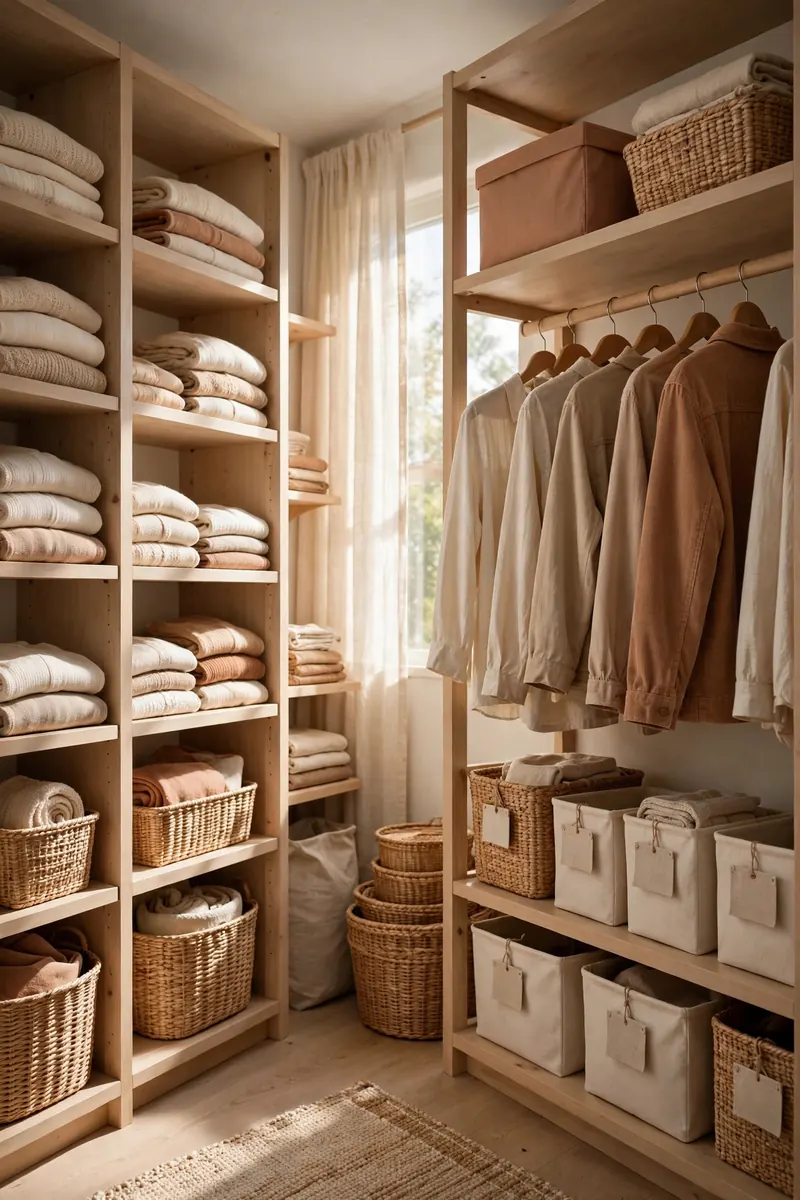
<!-- PINTEREST HERO IMAGE: Vertical 1000x1500 bright linen closet interior with perfectly folded white and sage towels, labeled woven bins, rolled sheet sets tied with ribbon, bold text overlay "15 Linen Closet Ideas" -->
The linen closet is a small space with a big problem
Most linen closets fail for one structural reason: deep shelves. The average linen closet shelf is 14 to 18 inches deep, but folded towels are only 10 to 12 inches — so every stack has a dark no-man's-land behind it where spare pillowcases and "mystery linens" accumulate for years. Add the classic leaning tower of bath towels, and you have the most avalanche-prone square footage in the house.
A working linen closet isn't about perfect folding. It's about three things: zones (every category has a home), containment (shelves get dividers and bins, not open stacks), and right-sizing (storing only what fits the household). These fifteen ideas rebuild the closet around how you actually use linens — grabbing a towel daily, changing sheets weekly, reaching for guest bedding twice a year.
> *Affiliate disclosure: Roomora is reader-supported. When you buy through links on this page, we may earn an affiliate commission at no extra cost to you.*
Reset before you reorganize
1. Empty it completely and sort by household, not by item
Take everything out — yes, everything — and sort into groups that match your home: master bath towels, kids' bath towels, sheet sets by bed size, guest bedding, beach/pool, and the "why do we own this" pile. Sorting by household zone (rather than by "all towels together") tells you instantly what belongs in this closet and what should live elsewhere.
Be ruthless with the keepers. Towels that have lost absorbency, sheets with thinning spots, and pillowcases from sets you no longer own are taking premium real estate from linens you use. A household of four doesn't need twelve bath towels in the main closet — four to six in rotation plus a small overflow is plenty. The rest can be demoted to cleaning rags (wash and store them with cleaning supplies, not here).
2. Measure shelf depth, height, and door swing
Before buying a single bin, measure: shelf depth, the vertical gap between shelves, and whether the door opens fully (bi-fold doors that only half-open change what you can reach). Deep shelves need pull-out solutions; short vertical gaps need low bins; narrow closets need slim organizers. This ten-minute step prevents the most common linen closet purchase regret: bins that don't fit the shelf. If this is part of a whole-home reset, the same measure-first discipline applies to small closet organization projects too.
Folding methods that actually hold
3. Learn the file fold for towels
The file fold (folding towels into rectangles that stand upright like files) is the single highest-impact linen closet technique. Folded stacks hide what's underneath and topple; file-folded towels stand in rows inside a bin or on a shelf, every towel visible, none disturbed when you grab one. Fold in thirds lengthwise, then fold the long rectangle into thirds again until it stands.
This works for hand towels, washcloths, and t-shirts equally well — the same technique appears in our under-bed storage systems for shallow bins. It takes practice on the first five towels and then becomes automatic.
4. Use the bundle fold for sheet sets
The sheet-set bundle solves the eternal problem of fitted sheets swallowing their matching flat sheet and pillowcases. Lay the flat sheet out, place the folded fitted sheet and pillowcases in the center, then fold the flat sheet around them into a neat package — and tuck one pillowcase over the outside as the "label" so you can identify the set at a glance.
Alternatively, store each complete sheet set inside one of its own pillowcases. Both methods mean grabbing bedding is a one-motion job instead of a three-shelf excavation. Sort bundles by bed size and keep the current rotation's sets at eye level.
5. Roll beach towels and bulky blankets
Beach towels, throw blankets, and quilts are too thick to file-fold neatly. Roll them tightly and stand the rolls in a deep bin or basket like a wine rack — this uses vertical shelf depth efficiently and makes each item grabbable without disturbing the rest. In a small bathroom, the same rolling technique turns a single shelf into a spa-style display.
Shelving and zone systems
6. Zone shelves by frequency of use
Assign each shelf a job: eye-level for daily towels, the shelf below for weekly sheet changes, the top shelf for guest bedding and seasonal items, and the floor (if any) for bulk overflow like extra pillows in vacuum bags. Frequency zoning means your hands go to the right shelf without thinking — and it stops the daily-grab items from migrating into the guest-bedding zone.
If multiple bathrooms share the closet, subdivide shelves by bathroom rather than by item type: "master bath" on the left, "kids' bath" on the right. Household-zone grouping beats item-type grouping in every shared closet.
7. Add shelf dividers to stop the lean
Open shelves are why towel stacks lean and topple. Inexpensive shelf dividers — clip-on, freestanding, or even simple bookends — create compartments that hold stacks upright. One divider per stack, positioned so stacks are 8 to 12 inches wide. Dividers are the cheapest structural upgrade in this entire guide and the one people skip most.
8. Use bins as drawers on deep shelves
Deep shelves waste their back half. Fix it with bins that act as drawers: choose bins nearly as deep as the shelf, fill each with one category, and pull the whole bin forward to access the back. Label the front of every bin. This converts a 16-inch-deep shelf from "stack in front, mystery behind" into fully usable storage — the same principle behind our under-sink organization pull-out systems.
9. Add a second layer with shelf risers
When vertical gaps between shelves are tall (12 inches or more), a shelf riser or small stacking shelf creates a second tier: everyday items below, lesser-used above, both visible. This is ideal for washcloths over hand towels, or current-season items over off-season. Measure the gap first — risers need at least 2 inches of clearance above the items they hold.
Containment: bins, baskets, and labels
10. One category per bin, labeled on the front
Bins earn their place when each holds exactly one category: "twin sheets," "beach towels," "table linens," "first aid and medicines" (yes, many linen closets double as the medicine shelf — give it a labeled bin too). Labels go on the front edge, large enough to read in dim closet light. A label maker is ideal; painter's tape and a marker work fine.
The discipline matters more than the containers. Matching bins look better, but a closet of mismatched bins with clear labels beats a closet of beautiful baskets with no system every time.
11. Corral small items in clear stackable drawers
Washcloths, pillowcases, and sachets disappear on open shelves. Small clear stackable drawers (the 3-drawer desktop style, sized for shelves) give them a home with visibility. Clear matters here: opaque drawers for small linens become mystery boxes within a month. Reserve one drawer for "orphans" — single pillowcases and unmatched items — and purge it quarterly.
12. Vacuum bags for the top shelf
Guest duvets, spare pillows, and off-season blankets compress dramatically in vacuum-seal bags, turning the hard-to-reach top shelf into high-density storage. Slide bags in flat, label them, and don't stack heavy bins on top (pressure pops seals over time). This is the same technique that powers holiday decor storage — bulky, seasonal, out of the way.
Maintenance and special cases
13. Keep a "to-fold" basket — and a rule for it
Clean laundry lands in the linen closet as a crumpled pile more often than anyone admits. Designate one basket or shelf section as the landing zone, with a hard rule: it gets folded and put away within 48 hours, and it never overflows onto other shelves. A visible landing zone with a deadline beats pretending every load gets folded immediately.
14. Store cleaning-adjacent items separately
The linen closet often absorbs overflow: light bulbs, wrapping paper, board games. Give each squatter category its own labeled bin at the bottom or top, or relocate them honestly — wrapping paper belongs with holiday storage, cleaning supplies with under-sink zones. A linen closet that stores everything stores nothing well.
15. Do a seasonal linen audit
Twice a year, pull everything out and check: threadbare towels get demoted to cleaning rags, stained sheets get retired, and anything that hasn't been used in a year leaves. Linens degrade — elastic fails, fibers thin — and a closet full of "backup" linens nobody reaches for is just delayed clutter. Fold this audit into your weekly cleaning schedule seasonal deep-clean weeks.
Frequently asked questions
How do I organize a deep linen closet?
Use bins as drawers: bins nearly as deep as the shelf, one category per bin, pulled forward to reach the back. Add shelf dividers to keep stacks upright, zone by frequency (daily at eye level, seasonal up top), and never leave open stacks on deep shelves — the back half becomes a graveyard.
What's the best way to fold sheets so the set stays together?
The bundle fold: fold the fitted sheet and pillowcases into the flat sheet, creating one package per set, with a pillowcase on the outside as identification. Or store each set inside one of its own pillowcases. Either method makes grabbing bedding a single motion.
How many towels should I keep in the linen closet?
For daily use, four to six bath towels per regular user in rotation is plenty, plus two to four guest towels and a small beach/pool set. More than that usually means worn-out towels are occupying space that fresh ones need. Demote the thinned-out ones to cleaning rags.
How do I keep folded towels from toppling?
Two fixes: shelf dividers that create 8-to-12-inch compartments, and the file fold so towels stand upright in rows instead of stacking. Stacks taller than about 10 inches topple no matter what — keep stacks short and compartments snug.
Should linens be stored in plastic bins or fabric baskets?
For closets (dry, indoor): either works. Fabric baskets breathe better and look warmer; plastic bins with lids protect against dust and are better for top-shelf, rarely-touched items. Avoid airtight plastic for anything slightly damp, and never store musty-smelling linens sealed — dry them fully first.
How often should I declutter the linen closet?
A quick quarterly check (pull orphans, refold the leaning stacks) plus a full twice-yearly audit where everything comes out. Linens wear out, household needs change, and the closet silently accumulates — small regular corrections beat annual overhauls.
Keep going
The linen closet shares its logic with every other deep-shelf zone in the house. Apply the bin-as-drawer system to your pantry and your laundry room, and use the same audit rhythm in your small bathroom.
Get the Sunday reset: one practical home idea in your inbox every week — subscribe free here. No spam, ever.
Pin title ideas
- 15 Linen Closet Organization Ideas (No More Towel Avalanche)
- The Sheet-Folding Trick That Keeps Sets Together Forever
- Small Linen Closet? 15 Systems That Actually Work
- How to Organize Deep Shelves: Linen Closet Edition
- 15 Linen Closet Ideas for Tiny Closets and Big Families