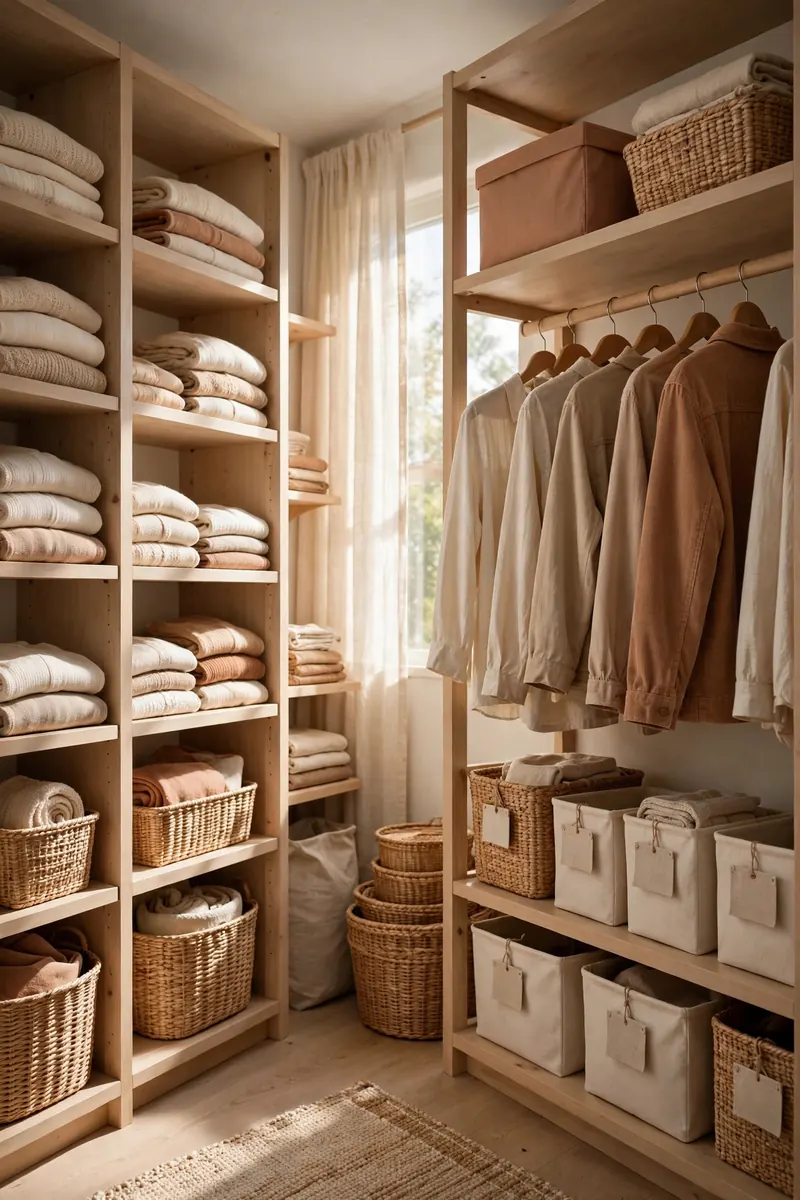
Why kids' rooms defeat most organizing systems
Kids' rooms are the hardest rooms in the house to keep organized, and it's not because kids are messy — it's because most organizing systems are designed for adults. A beautiful system with seventeen labeled compartments fails the moment a seven-year-old has to decide whether the dinosaur goes in "action figures — large" or "prehistoric creatures." The system has to match the child's brain, not the parent's aesthetic.
The secret: fewer categories, bigger containers, everything visible and reachable. A toddler can maintain "all blocks go in the big blue bin." Nobody maintains "sort by size, color, and franchise." Every system here follows one rule: if a child can't put it away in under ten seconds, it's too complicated.
These twenty ideas cover the four zones that matter — toys, clothes, the desk/homework area, and the general "stuff" that accumulates — plus the maintenance systems that keep it all working after the initial organizing high wears off.
Toy storage: the big battle
Toys are 80% of kids' room chaos. Win here and the room transforms.### 1. Sort toys into 4–6 big categories, maximum
Dump every toy in the middle of the room. Sort into broad piles: building toys, art supplies, dolls/action figures, vehicles, games/puzzles, stuffed animals. That's it — no subcategories. If a category has fewer than five items, merge it into the nearest one. Fewer, bigger categories are the entire game. A child can remember six homes for toys. They cannot remember sixteen.
2. Use open bins, not lidded boxes
Lids are the enemy. Every lid is a step a child won't take — they'll set the toy on top of the closed box instead. Open-top bins, fabric cubes without lids, or low baskets let kids toss toys in from across the room.
3. Label everything with pictures, not just words
Pre-readers need photo labels: tape an actual photo of the bin's contents on the front. Early readers get photo + word. Older kids get words. Picture labels serve double duty — they tell the child where things go AND make cleanup a matching game instead of a chore. Take the photos with your phone, print them cheap, tape them on. Update them when the bin's contents change.
4. Rotate toys instead of storing them all
Put half the toys in labeled bags or bins in a closet, garage, or under-bed storage. Every 4–6 weeks, swap. Rotation does three things: it halves the daily mess, it makes old toys feel new again (free entertainment), and it tells you what nobody misses — if a toy sits in rotation storage for two cycles untouched, donate it. Kids with fewer visible toys play longer and more creatively; this is well-documented, not just parental wishful thinking.
5. Give stuffed animals a defined home with a limit
Stuffed animals multiply. Give them one container — a hammock, a bean-bag-style storage chair, or a single large bin — and that's the limit. When it overflows, the child picks which ones stay. The "one in, one out" rule works here if the child chooses what leaves. Forcing it creates drama; choosing creates ownership.
6. Store games and puzzles vertically like books
Board game boxes stacked flat become an avalanche. Store them vertically on a shelf like books — every box visible, every box grabbable without moving five others. Use bookends or a small shelf divider to keep them upright. For puzzles, ditch the bulky boxes: put pieces in zip bags with the box cover cut out and taped on, stored in a single bin.
Closet systems: clothes kids can manage
Kids' closets fail when they're set up like adult closets — high rods, deep shelves, systems requiring reach and planning.
7. Lower the hanging rod to kid height
If your child can't reach the rod, they can't hang anything up — and everything ends up on the floor. Lower the rod (or add a second, lower rod) so the child can reach it standing flat-footed. A pull-down closet rod works for shared closets. This single change fixes more "clothes on the floor" than any other.
8. Ditch the dresser, use closet shelves for folded clothes
Dressers are where folded clothes go to become unfolded piles. Open closet shelving with labeled bins — "shirts," "pants," "pajamas" — beats drawers for most kids. They can see everything, grab without unfolding three other things, and toss items back approximately correctly. For small rooms, this also frees floor space the dresser was eating.
9. Do a weekly 10-minute closet reset together
Once a week, spend ten minutes: toss outgrown or stained items into a donate bag, re-fold the worst offenders, check for the missing shoe. Doing it together teaches the skill; doing it for them teaches nothing. Outgrown kids' clothes have excellent resale and donation value — bag them immediately instead of letting them clog the closet for months.
10. Keep only one week's worth of clothes accessible
Kids don't need thirty shirts in rotation. Keep 7–10 outfits accessible and store the rest. Fewer choices mean faster mornings, less laundry chaos, and a closet that stays manageable. Seasonal clothes get stored separately and swapped in. This also makes the outgrown-clothes purge obvious — when the accessible set shrinks, it's time to size up.
Desk and homework zone
Even young kids benefit from a defined work surface — for homework, art, or building.
11. Create a dedicated work zone, even in a small room
It doesn't need to be a full desk. A wall-mounted fold-down table, a small desk in the closet (the "cloffice" trick), or even a defined corner of a larger table works. The key is that it's always set up — a work zone that requires fifteen minutes of clearing before use never gets used. Keep basic supplies (pencils, paper, scissors) in a caddy that lives there permanently.
12. Use vertical storage above the desk
Desk surfaces attract clutter. Move supplies up: a pegboard, wall-mounted cups, or a small shelf above the desk holds everything within reach but off the work surface. Pegboards are ideal because the layout can change as the child's needs change — art supplies this year, school supplies next year, same board.
13. Give art supplies their own portable station
Art supplies spread. A rolling cart or handled caddy containing the full art kit — paper, crayons, markers, glue, scissors — means art happens at the desk (or kitchen table) and everything returns to one mobile home afterward. When the cart is parked, art time is over. Kids understand physical boundaries better than verbal rules.
Small kids' rooms: space tricks
Small rooms need the same systems, just compressed.
14. Go vertical with everything
Floor space is the scarcest resource in a small kids' room. Tall narrow bookshelves, over-door organizers, wall-mounted bins, and high shelves (for parent-managed items like rotation toys or craft supplies) use the walls the room already has. A loft or bunk bed frees the entire footprint underneath for a desk zone or play area — the highest-impact small-room change there is.
15. Choose furniture that stores
Every piece of furniture in a small kids' room should hold things: storage ottomans, beds with drawers, benches with cubbies, desks with hutches. If a piece of furniture is just a surface, it's wasting space. This matters more in kids' rooms than anywhere else because the stuff-to-space ratio is the worst in the house.
16. Keep the floor clear as the primary goal
In a small kids' room, floor space IS the play space. Every system should serve the goal of clear floor. That means: nothing stored on the floor that could go on a wall, under a bed, or in a closet. Under-bed rolling bins are the secret weapon — invisible storage that doesn't touch the precious floor area.
Systems that keep it working
Organization without maintenance is just a good weekend. These systems make it stick.
17. The 5-minute nightly reset
Before bed — or before screen time, which works better as leverage — five minutes: toys in bins (tossing counts), clothes in hamper or bins, desk cleared. Set a timer. Make it a race. Five minutes daily beats an hour on Saturday, and it teaches the habit that matters more than any bin system.
18. One-in, one-out for toys
New toy arrives, one leaves. Let the child choose which one goes — to donate, to a sibling, to rotation storage. This prevents the slow accumulation that defeats every system within six months. Birthdays and holidays are the danger zones; do the outgoing sort before the new toys arrive, not after.
19. Make cleanup a game, not a punishment
"Clean your room" is overwhelming. "How many blue things can you put away in two minutes?" is a game. Sorting races, timer challenges, and "find five things that don't belong" all work. The goal is associating tidying with normal routine, not with being in trouble. Kids who clean as a game become teenagers who clean as a habit — usually.
20. Audit the systems every season
Kids grow fast, and a system that worked at four fails at seven. Every few months, check: are the bins still the right size? Are the labels still accurate? Has the child outgrown the categories? Adjust the system to the child, not the child to the system. The best kids' room organization is the one that evolves.
More ideas you'll love
Frequently asked questions
How do I get my kids to keep their room organized?
Make the system match their ability: 4–6 big categories, open bins, picture labels, everything reachable. Then build the habit with a 5-minute nightly reset (timed, gamified). Systems too complex for the child's age will fail no matter how nicely you label them.
What's the best toy storage for small kids' rooms?
Open bins on low shelves with picture labels, plus toy rotation — store half the toys out of sight and swap every month. Under-bed rolling bins for overflow. Avoid lidded boxes (kids won't replace lids) and deep toy chests (everything vanishes to the bottom).
How many toys should a child have out at once?
Fewer than you think. Research consistently shows kids play longer and more creatively with fewer available toys. A practical target: enough to fill 4–6 open bins plus a small shelf of books. Rotate the rest. If a toy sits in rotation storage for two cycles untouched, donate it.
How do I organize a shared kids' bedroom?
Give each child defined zones — color-code bins, split the closet down the middle, assign sides of the room. Shared items (games, art supplies) go in neutral shared zones. Each child maintains their own zone; shared zones get cleaned together. Clear boundaries prevent 90% of shared-room conflict about mess.
What age can kids start organizing their own room?
Toddlers (2–3) can toss toys into open bins with picture labels — that's real organizing. By 4–5 they can sort into 3–4 categories. By 7–8 they can maintain a simple system independently with a nightly reset. Match the system's complexity to the age; a system a child can't run alone isn't a kids' system.
How do I handle the stuffed animal explosion?
One container, that's the limit — a hammock, storage bean bag, or large bin. When it overflows, the child chooses what stays. "One in, one out" for new ones. Donate the outgoing ones together so the child sees where they go. Forcing it creates drama; choosing creates ownership.
Keep going
Kids' room systems use the same principles as the rest of the house — zones, visibility, and maintenance. Apply them to your small closets and pantry next.
Get the Sunday reset: one practical home idea in your inbox every week — subscribe free here. No spam, ever.