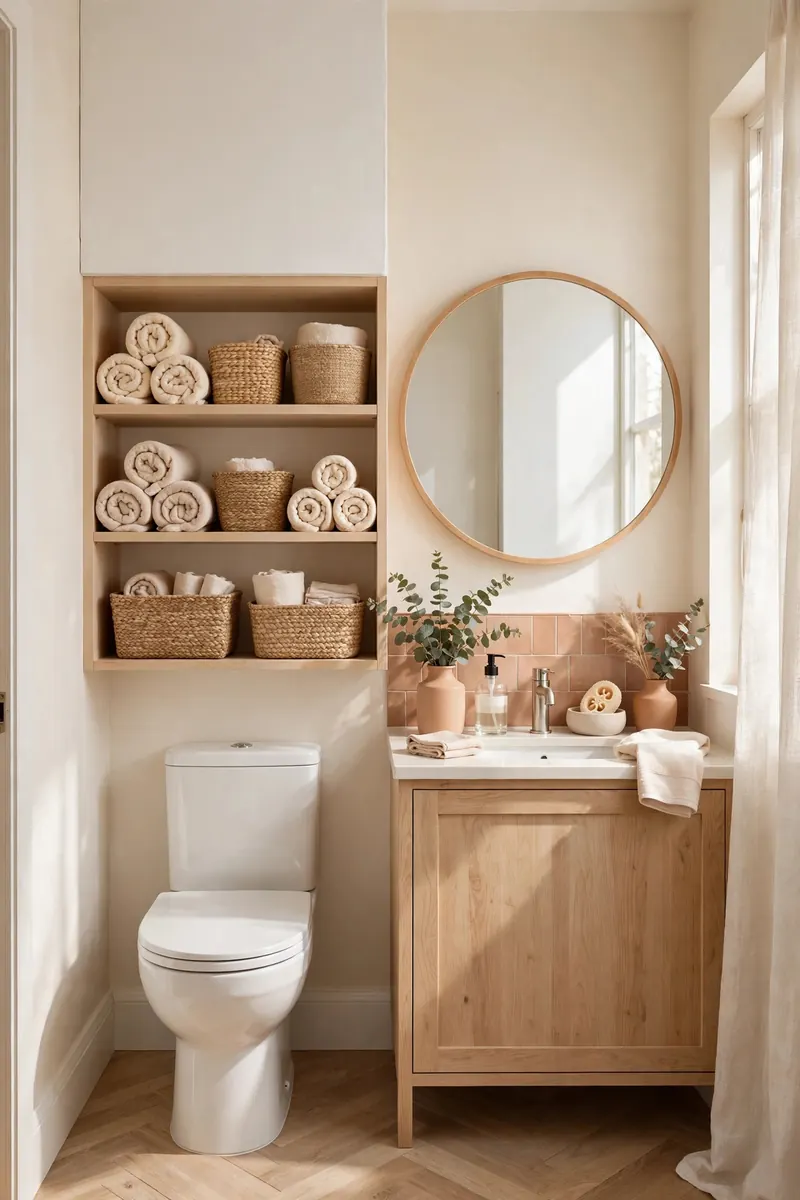
Think in layers
Small bathrooms have more storage than it seems — it's just hiding in the walls, above the toilet, inside the vanity, and behind the mirror. Most people only use the vanity and call it done, leaving half the room's storage potential untouched.
The trick is thinking in layers: walls, vanity interior, shower, door, and even the ceiling-adjacent space above eye level. Work through each layer systematically, and a bathroom that felt hopeless starts feeling generous. These thirteen ideas cover every layer, with renter-friendly options throughout.
The walls: your biggest untapped resource
Walls are the single largest underused surface in small bathrooms. Floor space is precious; wall space is free.
1. Over-toilet shelving
The wall above the toilet is the single biggest wasted space in small bathrooms. It's roughly two feet wide and three feet tall of prime storage that most bathrooms leave completely empty. Open shelves or a narrow cabinet here hold towels, toiletries, extra toilet paper, and even a small plant.
Open shelves keep things visible and accessible — ideal for items you grab daily. A cabinet with doors hides visual clutter — better if the bathroom is visible from living areas or you prefer a calmer look. Either way, mount shelves at a height where you can reach without stretching (usually starting about 24 inches above the toilet tank) and keep the depth shallow (8-10 inches) so nothing feels like it's looming over you.
2. Floating shelves beside the mirror
Two narrow shelves flanking the mirror keep daily items within reach without crowding the sink. This is where your toothbrush, skincare, and contact lens case live — the things you use every morning and night. Keeping them on shelves instead of the sink rim means the sink stays clear for actual washing, and cleanup takes seconds.
Keep these shelves minimal: daily items only. If a shelf starts collecting extras, that's a sign those extras belong in the vanity or over-toilet storage instead.
3. Towel ladders
A leaning ladder holds multiple towels in a few inches of floor space — and looks intentional rather than improvised. Unlike hooks (one towel per hook) or bars (limited capacity), a ladder's rungs each hold a towel, turning a narrow strip of wall into drying space for three or four towels.
Choose a ladder narrow enough to fit your wall (many are under 20 inches wide) and make sure the feet sit flat — wobbly ladders in humid bathrooms are a hazard. Bamboo and teak handle moisture well; painted wood needs occasional resealing.
4. Wall-mounted cabinets
Where open shelves feel too exposed, a shallow wall-mounted cabinet (6-8 inches deep) adds concealed storage without jutting into the room. Mount one beside the mirror or above the towel ladder for medicines, first aid, and items you want hidden. Many come with mirrored fronts, doubling as an extra mirror.
The vanity: make the inside work as hard as the outside
The vanity is the bathroom's workhorse, but most vanities waste half their interior to poor organization.
5. Drawer dividers
Vanity drawers become junk drawers without dividers — everything migrates into a tangled pile within weeks. Small trays, bamboo organizers, or adjustable spring dividers give everything a home: one section for dental, one for skincare, one for hair tools. The rule is simple: every category gets a bounded space, and nothing floats loose.
Measure your drawers before buying dividers. Adjustable dividers handle odd sizes; custom-cut foam or cardboard works for truly unusual drawers and costs almost nothing.
6. Under-sink organizers
The cabinet under the sink is an obstacle course of pipes, but stackable shelves or pull-out caddies double the usable space around them. A two-tier sliding organizer lets you pull everything forward instead of kneeling and reaching into the dark. Use the lower tier for cleaning supplies and backstock, the upper for daily items.
Tension rods mounted horizontally inside the cabinet create a hanging rail for spray bottles — an instant second level that costs a few dollars and needs no tools.
7. Inside-cabinet door racks
Adhesive or over-door racks on the inside of vanity doors hold hair tools, brushes, and cleaning supplies in space that was doing nothing. This is pure found storage: the door interior is typically 18-24 inches tall and completely unused. Narrow wire racks or adhesive caddies mount in minutes.
For heat tools (straighteners, curling irons), use a heat-resistant holder — standard plastic caddies can warp. Let tools cool before storing, or mount the holder where air circulates.
The shower: vertical space most people ignore
8. Corner caddies
Tension-pole corner caddies use vertical shower space without drilling — shelves stack from tub to ceiling in a corner that was holding nothing. They're ideal for shared bathrooms where everyone needs their own shelf. Look for rust-resistant materials (aluminum, stainless, or coated wire) since cheap chrome rusts fast in hard water areas.
9. Over-the-showerhead organizers
If you rent, an over-the-showerhead caddy adds two shelves of storage with zero holes and zero adhesive. It hangs on the shower arm in seconds. Choose one with drainage holes so water doesn't pool, and don't overload it — most are rated for a few pounds, not a full product collection.
10. Shower niches and ledges
If you own and are renovating, a recessed shower niche is the gold standard — storage carved into the wall, completely flush, nothing to clean around. For a no-renovation version, a corner shelf with strong adhesive or a suction-mounted ledge gives you a fraction of the benefit with none of the construction.
Renter-friendly upgrades
Renters can add serious bathroom storage without losing a deposit. The key is choosing solutions that remove cleanly.
11. Adhesive hooks and shelves
Modern adhesive strips hold surprising weight — up to several pounds per strip when applied to clean, dry tile or glass. Use them for robes, shelves, and organizers. The trick is surface prep: clean with rubbing alcohol, press firmly for 30 seconds, and wait the full cure time (usually an hour) before loading. Removal is clean with the pull-tab — no holes, no damage.
12. A rolling cart
A slim rolling cart (many are under 8 inches wide) beside the vanity or toilet adds three tiers of storage that moves when you clean. Use the top for daily items, middle for backstock, bottom for cleaning supplies. When guests come, roll the whole thing into a closet. It's the most flexible bathroom storage there is.
13. Over-door organizers
The back of the bathroom door is a full extra wall. Over-door hooks hold robes and towels; over-door pocket organizers hold toiletries, cleaning supplies, or styling tools. Measure door clearance first — thick organizers can prevent the door from closing fully.
Visual space tricks: make it feel bigger
Storage solves the practical problem; these tricks solve the psychological one. A bathroom with great storage still feels cramped if it looks cluttered.
14. Large mirror
The bigger the mirror, the bigger the bathroom feels — it doubles the visual space by reflecting the room back at itself. Replace a small medicine-cabinet mirror with the largest your wall allows. A mirror that spans the full vanity width is transformative. If you need medicine-cabinet storage, get a large mirrored cabinet instead of mirror-plus-small-cabinet.
15. Clear shower curtain
A clear or light curtain keeps sightlines open all the way to the back wall, making the room feel twice as deep. Frosted glass doors work even better if you own the place — they read as a design feature rather than a barrier. Avoid dark or heavily patterned curtains in small bathrooms; they visually chop the room in half.
16. Light colors, one accent
White or pale walls with a single accent (towels, art, a plant) keep small bathrooms feeling fresh, not busy. Every additional color and pattern adds visual noise that shrinks the space. This doesn't mean sterile — warm whites, pale sage, and soft gray all work. Just commit to a restrained palette and let one accent provide personality.
17. Contain everything
The ultimate visual trick: if every item has a container, the room reads as calm even when full. Bins, baskets, and closed storage turn twenty small objects into three clean shapes. This is why the storage ideas above matter twice — they add capacity and they reduce visual chaos simultaneously.
Frequently asked questions
How can I add storage to a bathroom with no vanity?
Use over-toilet shelving, a rolling cart, wall-mounted cabinets, and the back of the door. A pedestal-sink bathroom can still hold plenty with vertical storage — the walls and door are doing the vanity's job. A tall narrow linen tower in a corner can replace vanity storage entirely.
What's the best renter-friendly bathroom storage?
Tension rods, adhesive shelves and hooks, over-toilet etageres (freestanding, no mounting), and rolling carts — all removable, no holes required. Freestanding over-toilet units are the renter's best friend: they add massive storage and move with you.
How do I keep a small bathroom from looking cluttered?
Contain everything: bins, baskets, and closed storage. If every item has a container, the room reads as calm even when full. Limit what's visible to daily items only; everything else goes behind a door or in a bin.
Should I choose open shelves or closed cabinets?
Open shelves for daily items you grab constantly (visibility = speed). Closed cabinets for everything else (concealment = calm). Most small bathrooms need both: open near the mirror, closed for backstock and less-attractive necessities.
How do I prevent mold in bathroom storage?
Ventilation matters more than containers. Run the fan during and 20 minutes after showers, choose rust-resistant and moisture-tolerant materials (no raw MDF), and avoid storing towels in sealed containers while damp. Bamboo and teak handle humidity naturally.
Keep going
Small bathrooms reward the same systems thinking as any tight space. For more ideas, see our pantry organization guide — zones and bins work everywhere.