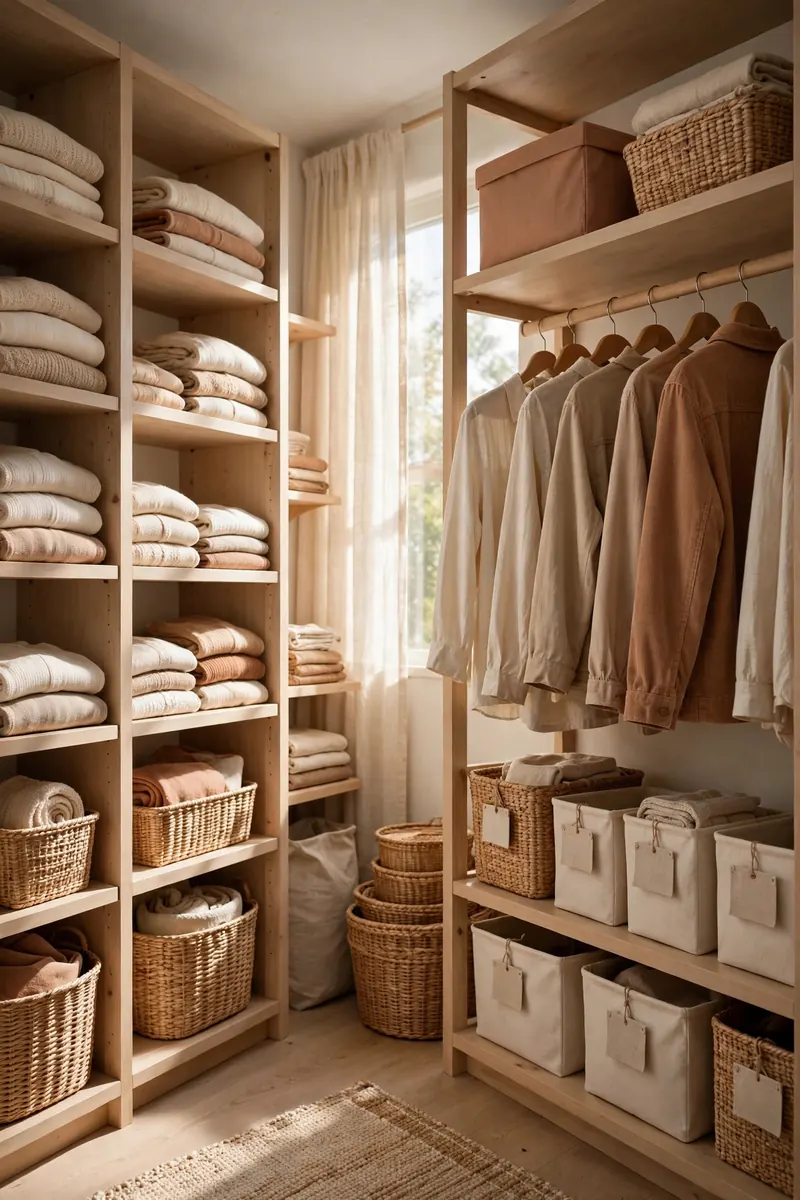
<!-- PINTEREST HERO IMAGE: Vertical 1000x1500 serene small nursery with white crib, rolling diaper cart with labeled bins beside the changing table, open closet with folded baby clothes in soft neutrals, warm lamp glow, bold text overlay "14 Nursery Organization Ideas" -->
A small nursery needs systems, not square footage
A nursery is the hardest-working small room in the house. In 80 to 120 square feet it has to store three sizes of clothing at once (current, next-up, and outgrown), run a diaper station you'll visit eight to twelve times a day, host feeding sessions at 3 a.m., and somehow stay calm enough for a baby to sleep in. The rooms that work aren't the big ones — they're the ones where everything has a one-handed, eyes-half-closed retrieval system.
The defining constraint of nursery organization is that you'll use it exhausted, often holding a baby. That means open containers beat lidded ones at the changing station, labels need to be readable in dim light, and the most-used supplies must live within arm's reach of where you stand — not across the room in a "proper" storage spot. These fourteen ideas are built around that reality: zones that match how you actually move through the room, rotation systems for the endless clothing churn, and honest trade-offs about what a tiny nursery can and can't hold.
> *Affiliate disclosure: Roomora is reader-supported. When you buy through links on this page, we may earn an affiliate commission at no extra cost to you.*
Zone the room before organizing anything
A nursery has four functional zones, and in a small room they often overlap — that's fine, as long as each zone has a defined home:
- Sleep zone: the crib, nothing else. Keep this zone ruthlessly clear — safe-sleep guidelines mean a bare crib, and visual calm here helps everyone.
- Changing zone: the dresser-top changer or changing table plus its supply radius (about 3 feet in every direction).
- Feeding zone: the glider or chair, a side table, and whatever supports long sessions — water, burp cloths, nursing pillow storage.
- Storage zone: the closet and any dresser drawers not used for changing supplies.
In a room under 100 square feet, the feeding and changing zones often share a wall. That's workable if the side table serves both — more on that below. Sketch the four zones on paper before buying a single bin; most nursery clutter comes from supplies that never got assigned to a zone and drift.
The diaper station: your most-visited 3 square feet
1. Build the station around the one-handed rule
You'll change diapers thousands of times, many while holding a squirming baby with one arm. Every item at the station — diapers, wipes, cream, spare onesie, diaper bags — must be retrievable with one hand and restockable without rearranging. That rules out lidded boxes, stacked containers, and anything that requires two hands to open.
The practical setup: a dresser top with a changing pad, plus a tiered organizer or divided caddy holding diapers upright (not stacked flat — upright lets you grab one without disturbing the pile), wipes in a weighted dispenser that pops one at a time, and cream in a pump bottle instead of a squeeze tube. A small trash can or diaper pail within the 3-foot radius completes the loop. Test the whole station one-handed before the baby arrives; if you need to put the (imaginary) baby down to grab the wipes, redesign.
2. Use a rolling cart as a mobile diaper station
A three-tier rolling cart beside the changing area is the highest-value nursery purchase for small spaces. It holds the full diaper inventory in labeled open bins, rolls to the living room for daytime changes (so you don't climb stairs twelve times a day), and later converts to art-supply or toy storage when diapers are history.
Load it by frequency: top tier for daily supplies (diapers, wipes, cream), middle for backups (spare clothes, extra wipes packs, diaper bags), bottom for bulk overflow (the jumbo diaper pack, spare sheets). Keep the cart's footprint under 18 inches wide so it tucks beside the dresser without blocking the 30-inch traffic lane to the crib.
3. Stock a "blowout kit" at every changing spot
Every changing location — nursery station, rolling cart, diaper bag — gets a sealed pouch containing one spare outfit (sized up, not current size, because blowouts happen during growth spurts), two diapers, a travel wipes pack, a disposable bag, and a spare crib sheet or changing pad cover. This kit is the difference between a 3-minute recovery and a 20-minute laundry emergency at midnight.
Restock the kit the moment you use it — "I'll refill it tomorrow" is how the next blowout finds you unprepared. Keep one spare pouch pre-packed in the closet so restocking is a grab, not a packing session.
The feeding corner: built for the 3 a.m. shift
4. Anchor the chair with a loaded side table
The feeding chair is where you'll spend the most stationary hours of the first year, so its side table is mission-critical. Within arm's reach: a large water bottle (nursing is dehydrating — a 32-ounce bottle you fill once beats constant refills), burp cloths (keep five, not two), your phone charger with a long cable, a dimmable lamp or clip light, and a small lidded bin for snack wrappers.
The table itself should be 20 to 24 inches tall — level with the chair arm — and stable enough not to tip if you lean on it half-asleep. A C-shaped side table that slides under the chair works in the tightest corners, giving you a surface with zero extra footprint. This is the one nursery zone where "pretty" loses to "reachable in the dark."
5. Create a nursing-pillow home (not the floor)
Nursing and feeding pillows migrate — they end up on the floor, on the crib rail, wedged behind the chair. Give the pillow a dedicated hook or a slot beside the chair: an over-the-door hook on the closet door, a wide wall hook at chair height, or simply the arm of the chair itself as its permanent parking spot. The rule is the pillow lives in exactly one place when not in use, because a feeding pillow on the floor at 3 a.m. is a tripping hazard and a hygiene problem.
If space allows, a lidded basket beside the chair corrals the pillow plus the spare burp cloths and a muslin blanket — one container, one zone, nothing on the floor.
Clothes: the rotation system that ends the chaos
6. Sort clothes into three active bins: now, next, outgrown
Baby clothes arrive in waves and get outgrown in weeks, which is why nursery closets explode. The fix is a permanent three-bin rotation in the closet or on a shelf: Now (current size, in the dresser drawers), Next (one size up, washed and ready in a labeled bin), and Outgrown (sealed bag or bin for storage, donation, or hand-me-downs).
The critical discipline: when you notice the current size getting snug, the Next bin is already washed and waiting — no emergency laundry, no digging through gift bags. And the Outgrown bin gets sealed and moved out of the nursery (top of the closet, under-bed storage, or another room) the moment it's full. Outgrown clothes sitting in the nursery are the number-one source of closet chaos. For the under-bed overflow, the bin-and-label system in our under-bed storage ideas adapts perfectly to outgrown baby clothes.
7. File-fold baby clothes so you can see everything
Baby clothes are small enough that stacked piles become archaeological digs — you lift five onesies to find the one with the snaps that still work. File-folding (folding each item into a rectangle and standing it upright in the drawer, spine-up like files) lets you see every item at a glance and pull one without disturbing the rest.
Sort drawer rows by type, not color: all short-sleeve onesies in one row, sleepers in the next, pants in the third. In dim nursery light at midnight, type-sorting beats color-sorting every time. Drawer dividers or small fabric bins keep the files standing upright — without dividers, file-folded baby clothes slump within a week.
8. Cap the wardrobe at what fits the system
Babies need far fewer clothes than the gift pile suggests: roughly 8 to 10 onesies, 5 to 7 sleepers, 4 to 5 pants, and 2 to 3 outfits per size is plenty with twice-weekly laundry. Everything beyond that is closet clutter that slows down the 6 a.m. dress-the-baby routine.
When new clothes arrive, apply one-in-one-out at the drawer level: if the onesie drawer holds ten and three new ones arrive, three move to the Next or donation bin immediately. This isn't minimalism for its own sake — it's protecting the file-fold system, which only works when drawers aren't overstuffed. Small closets especially benefit from strict caps; our small closet organization ideas cover the vertical tricks that stretch a tiny nursery closet further.
Small-space storage wins
9. Take the closet door off (or replace it with a curtain)
In a tiny nursery, a swinging closet door eats 8 to 10 square feet of swing arc — floor space you can't put furniture on and can't walk through. Removing the door (store the hinges and screws in a labeled bag taped inside the closet) instantly reclaims that arc and turns the closet into open, visible storage you'll actually use.
If the open closet looks chaotic, hang a simple curtain on a tension rod — it hides the visual noise, costs almost nothing, and swings aside with zero footprint. Renters: this is fully reversible, and landlords rarely object since you're not modifying anything. The visibility bonus is real: open closets get maintained; closed closets become black holes.
10. Use the back of the door and every inch of wall
The nursery door's interior face is prime organization real estate: an over-the-door organizer with clear pockets holds lotions, thermometers, nail clippers, extra pacifiers, and all the small items that otherwise colonize the dresser top. Clear pockets matter — you'll find the nasal aspirator at 2 a.m. only if you can see it.
Walls take the rest: floating shelves above the dresser for the items you use standing up (keep daily items below shoulder height — high shelves are for display and backup stock), a peg rail for the diaper bag and coming-home outfit, and wall-mounted book slings for the board-book collection. Floor space in a nursery is sacred; walls are free.
11. Choose a dresser that does double duty
In a small nursery, the dresser is the changing table — a standard dresser (34 to 36 inches tall) with a contoured changing pad secured on top. This eliminates an entire piece of furniture. Dedicate the top two drawers to changing supplies (diapers, wipes, creams, spare outfits) so the station is self-contained, and use the lower drawers for the Now clothing rotation.
Secure the dresser to the wall — this is non-negotiable once the baby pulls to standing and yanks drawers. Anti-tip straps are cheap and invisible. And skip the dedicated changing table entirely unless the nursery is large; in a small room, single-purpose baby furniture is a luxury the floor plan can't afford. The same double-duty logic applies across the house — our kids' room organization ideas extend it as the baby becomes a toddler.
Toys, books, and the stuff creep
12. Start the toy rotation on day one
Babies don't need many toys, but they accumulate them fast. A toy rotation — 6 to 8 toys out, the rest in a labeled bin in the closet — keeps the small nursery calm, makes old toys feel new when they rotate back in, and teaches the household the containment habit early. Rotate every one to two weeks, or whenever the baby loses interest.
In a tiny nursery, the "out" toys live in exactly one bin, not scattered across closets. When the bin is full, something leaves the house before something new enters. Starting this discipline with a 6-month-old is infinitely easier than imposing it on a 3-year-old. As the collection grows, our toy storage organization ideas scale the system up.
13. Book slings instead of a bookcase
A traditional bookcase is overkill for board books and eats 12 inches of floor depth. Fabric book slings mounted at baby height display books cover-out (which is how babies actually choose them), take zero floor space, and hold a surprising number — a 32-inch sling rail fits 15 to 20 board books.
Mount the lowest sling at about 20 inches off the floor so a cruising baby can reach without climbing. Keep the total collection capped at what the slings hold; the overflow bin lives in the closet under the same one-in-one-out rule as clothes.
Keep it safe and sane
14. Safety-proof the organization itself
Every storage decision in a nursery has a safety dimension. Anchor all dressers, bookcases, and shelving to the wall — tip-overs are a leading nursery hazard. Keep small items (batteries, magnets, coin-sized objects) in latched containers above 36 inches, never in open door-pocket organizers a toddler can reach. Route lamp and monitor cords behind furniture with cord covers; a dangling cord near the crib is both a strangulation and a pull-down risk.
And keep the crib zone empty: no shelves above the crib (things fall), nothing stored on the crib rail, and the monitor mounted on the wall rather than perched where little hands will eventually reach. Organization that isn't safety-checked is just attractive hazard storage.
Mistakes that break a small nursery
Buying the full furniture set. Crib, dresser, glider, changing table, bookcase, toy chest — the standard nursery set assumes a 150-square-foot room. In a small nursery, every piece must earn its footprint; the dresser-changer combo and wall-mounted storage replace two or three standalone pieces.
Storing "someday" items in the nursery. The breast pump you'll use in a month, the size 12-month clothes for next season, the keepsake box — each one steals space from the daily system. Someday items live elsewhere in the house (a hall closet, under your bed) until their day comes.
No labeling because "I'll remember." Sleep deprivation erases memory. Label the Next-size bin, the diaper sizes, the medicine drawer — big, high-contrast labels readable in lamplight. The five minutes of labeling pays back every single night.
Organizing once instead of building routines. A nursery reorganized the week before birth degrades within a month without maintenance habits: the nightly 5-minute reset (restock the station, return the pillow, toss laundry in the hamper), the weekly bin check, the monthly size audit. Systems beat events. A weekly cleaning schedule adapted to nursery tasks keeps the reset from becoming a weekend project.
Frequently asked questions
How do I organize a nursery with no closet?
Go vertical and mobile: a freestanding garment rack (under 40 inches wide) for hanging clothes, the three-bin rotation (now/next/outgrown) on a bookshelf or cube unit, and a rolling cart as the diaper station. Over-the-door organizers on the nursery door add pocket storage with zero footprint. Many families find a well-organized open system easier to maintain than a cramped closet anyway.
What's the best way to organize baby clothes by size?
The three-bin rotation: current size file-folded in dresser drawers, next size up washed and stored in a labeled bin on a closet shelf, outgrown sealed in a bag and moved out of the nursery. Label bins with both the size and the approximate age range ("6–9 months"), since brands size inconsistently. Audit monthly — babies outgrow sizes faster than you expect.
How many diapers should I keep at the changing station?
Keep a 2-to-3-day supply at the station itself (roughly 20 to 30 diapers for a newborn) in an open upright organizer, with bulk stock in the closet or on the cart's bottom tier. Restock from bulk weekly. Keeping the full jumbo pack at the station eats precious surface area and tempts overstuffing; the station should hold days, not weeks.
Where should the crib go in a small nursery?
Against the longest solid wall, away from windows (cord and blind hazards, plus drafts and direct sun), and with at least 2 feet of clearance on one long side for access. Never under a shelf or wall hanging. In a very small room, the crib can share a wall with the dresser — just keep the changing supplies out of the baby's reach from the crib.
How do I keep a small nursery from smelling?
The diaper pail is the main culprit: empty it every 2 to 3 days (daily in summer), use scented bags for the worst offenders, and sprinkle baking soda in the pail bottom. Ventilate the room daily — even ten minutes of open window helps enormously. Wash the changing pad cover weekly and keep a small lidded trash can at the station for wipes so they don't sit in the open pail.
When should I switch the nursery to toddler organization?
Start the transition around 12 to 15 months: lower the book slings and toy storage to toddler height, move hazardous items (medicines, small objects) above 36 inches, and convert the crib when climbing starts. The rotation systems — clothes, toys — carry straight over; only the heights and the safety boundaries change. Our kids' room organization guide picks up where the nursery leaves off.
Keep going
The nursery is one room in a house that's about to get busier. Extend the rotation logic to the linen closet for the endless sheet swaps, keep the laundry pipeline moving with laundry room organization ideas, and run the whole house on a room-by-room declutter guide before the baby's first birthday doubles the stuff.
Get the Sunday reset: one practical home idea in your inbox every week — subscribe free here. No spam, ever.
Pin title ideas
- 14 Nursery Organization Ideas for the Tiniest Nurseries
- Small Nursery? These 14 Systems Make It Work Like a Dream
- The 3-Bin Baby Clothes Rotation That Ends Closet Chaos
- 14 Tiny Nursery Storage Ideas (Diaper Station to Toy Rotation)
- Nursery Organization Ideas That Survive the 3 A.M. Shift