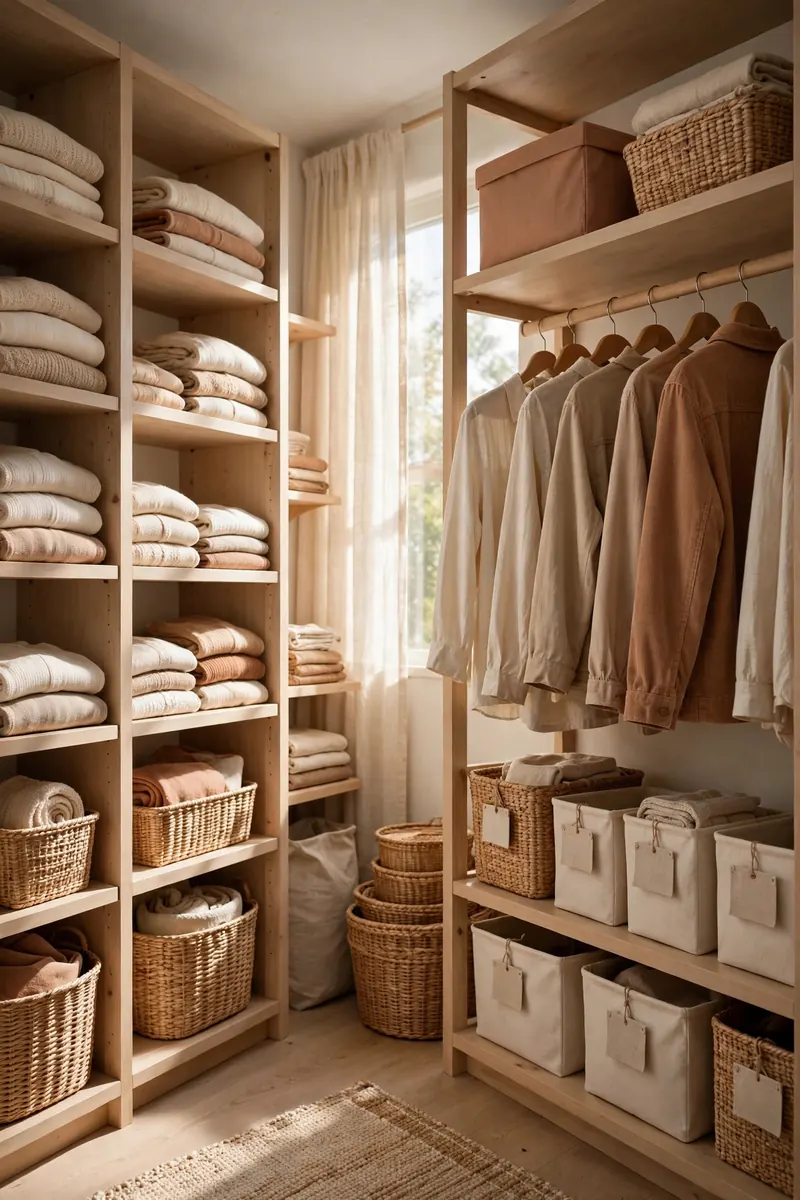
<!-- PINTEREST HERO IMAGE: Vertical 1000x1500 image of a bright, tidy playroom — low white shelving with colorful labeled bins, a few toys neatly arranged, soft round rug, natural light; overlay text "TOY STORAGE IDEAS THAT WORK" in playful bold letters on a sunny yellow banner -->
# Toy Storage Ideas That Actually Work
Every parent knows the cycle: you spend Saturday organizing the toys, and by Tuesday the living room looks like a toy store exploded. The problem usually isn't your organizing skills — it's that most toy storage advice ignores how kids actually play. Kids don't maintain adult systems. They need systems designed for small hands, short attention spans, and the physics of dumping.
These ideas come from what actually survives contact with real children: fewer toys in rotation, bins a toddler can manage, and cleanup routines that don't require parental nagging. The goal isn't a magazine playroom — it's a home where toys get played with, put away without a battle, and stop colonizing every room.
> *Affiliate disclosure: Roomora is reader-supported. When you buy through links on this page, we may earn an affiliate commission at no extra cost to you.*
Why toy organization keeps failing
Before the ideas, the diagnosis. Toy systems fail for predictable reasons:
Too many toys are out at once. The average kid plays with a fraction of what they own. When everything is available, nothing holds attention — kids dump bins looking for something interesting because nothing looks interesting in the chaos. Fewer visible toys means deeper play and easier cleanup.
The system requires adult precision. If putting away requires sorting 47 tiny pieces into labeled compartments, kids won't do it — and honestly, neither will tired parents. Kid systems need to be dump-friendly: big bins, broad categories, everything within reach.
Toys live everywhere. When toys colonize the living room, kitchen, and bathroom, no system can contain them. Toys need a home base. A small satellite basket in the living room is fine; a whole-house sprawl is not.
Nobody declutters. Kids outgrow toys constantly, but the old ones stay, doubling the volume every birthday and holiday. Without regular outflow, any system drowns.
Fix these four, and almost any storage furniture will work. Ignore them, and no amount of cute bins will save you.
The toy rotation system (the highest-leverage idea)
Toy rotation is the single most effective toy management strategy, and it's simple: only a portion of the toys are available at any time; the rest are stored away and swapped periodically.
How to set it up:
- Gather every toy in the house into one room (yes, all of them — it's shocking)
- Sort into categories: building, pretend play, art, puzzles/games, books, active play, comfort items
- Declutter first — broken, outgrown, and unloved toys leave now (see our declutter room by room guide for the kids' room process)
- Divide what remains into 3-4 rotation sets, each with a mix of categories
- Put one set out; box the rest in labeled bins in a closet or basement
- Swap sets every 2-4 weeks, or when interest fades
What happens: kids play more deeply with fewer toys, cleanup takes minutes, and every rotation feels like Christmas morning — old toys become new again. Parents consistently report that rotation cuts toy mess by half or more, because there are simply fewer toys to scatter.
What stays out permanently: comfort items (stuffed animals, blankets), current favorite toys, books (rotate these too, but keep a solid base), and art supplies. Don't rotate away a child's beloved lovey — that's not clutter, that's emotional security.
16 toy storage ideas that survive real kids
Bins and containers
1. One bin per broad category — no more
Building toys. Dolls and figures. Cars and tracks. Art supplies. Games and puzzles. Dress-up. That's six bins, max, for most families. Broad categories mean a four-year-old can sort correctly: cars go in the car bin. When categories get narrow ("LEGO Technic pins"), only adults can maintain them, which means nobody maintains them.
2. Picture labels, not just word labels
Pre-readers can't read "Puzzles." Add a photo or simple drawing of the category on each bin — a picture of blocks on the block bin. Kids as young as two can match pictures. Take the photos yourself with your phone, print them, and tape them on. It takes twenty minutes and transforms cleanup from a guessing game into a matching game.
3. Open bins beat lidded bins for daily toys
Every lid is a barrier. For toys in active rotation, use open-top bins, cubby shelves, or baskets with no lids. Lids are for the rotation storage in the closet, not for daily use. If a bin needs a lid to look tidy, the category is probably too narrow — broaden it.
4. The "dump bin" is a feature, not a failure
Keep one large bin with no category — the everything bin. When cleanup time comes and a toy's home isn't obvious, it goes in the everything bin. Once a week, an adult sorts it properly (takes five minutes). This prevents the perfectionism that makes kids give up on cleaning entirely.
Furniture and layout
5. Low, open shelving at kid height
The best toy shelf is one a toddler can reach without climbing: 2-3 cubbies high, sturdy enough to survive being used as a climbing frame (because it will be). Cube shelving units are the standard for a reason — each cube holds one bin, everything is visible, and kids can reach it all. Anchor it to the wall. Always anchor it.
6. A dedicated art station — contained, not spread
Art supplies multiply and migrate like nothing else. Contain them: one rolling cart or caddy with three tiers — coloring on top, paper in the middle, supplies below. The cart rolls to the table for art time and rolls back to its parking spot after. When art supplies live in one mobile unit, they stop appearing in every room.
7. Stuffed animal zoo or bean bag storage
Stuffed animals are the kudzu of toys — they expand to fill all available space. Two solutions that work: a "zoo" (a mesh-front enclosure they get "put to bed" in — kids love this) or a giant bean bag chair with a zipper that you stuff full of plush toys. The bean bag is genius: it stores dozens of stuffies and becomes seating.
8. Vertical LEGO and building-toy storage
Small building pieces need a different approach: a play table with built-in storage bins underneath, or stackable drawer units sorted loosely by color (not by piece type — that's adult-level sorting). A large flat tray or mat defines the build zone and makes cleanup a matter of tipping the mat into the bin.
Small-space solutions
9. The single living-room basket rule
In small homes without a playroom, toys get one basket in the living room — not a corner, not a shelf, one basket. When it's full, something has to leave before something new enters. This hard limit is what makes small-space toy management work. Our small living room ideas and space-saving furniture for small apartments complement this approach.
10. Behind-door and under-furniture storage
Over-door organizers hold dolls, action figures, and small toys in dead space. Under-couch rolling bins hide the current rotation set. Under-bed storage works for out-of-rotation toys in kids' bedrooms. Small spaces require using every dead zone.
11. Fold-down and multi-use play surfaces
A wall-mounted fold-down table becomes an art desk or LEGO station, then disappears. An ottoman with storage holds toys and provides seating. In small apartments, every toy storage piece should do double duty — see renter-friendly apartment decor ideas for more dual-purpose thinking.
Systems that keep it working
12. The 10-minute cleanup song routine
Set a timer for ten minutes before dinner or bedtime. Everyone cleans — parents included. Make it a game: beat the timer, sort by color, "rescue" toys back to their homes. Ten minutes with the whole family resets any room. The key is daily consistency, not weekend marathons.
13. One-in-one-out, enforced at gift time
Birthdays and holidays are when toy volume doubles. Institute the rule before the next gift occasion: for every new toy that enters, the child chooses one to donate. Frame it positively — "another kid would love this" — and let them pick. Most kids adapt to this quickly, and some embrace it.
14. The toy library box for grandparents' houses
If grandparents buy lots of toys, suggest a toy library: a box that stays at their house. Kids get novelty on visits, your house stays manageable, and grandparents feel generous. Everyone wins.
15. Quarterly toy audits with the kids
Every three months, pull out the rotation bins and ask: "What haven't you played with?" Let kids choose donations. You'll be amazed how readily they let go of things they were "definitely still playing with" once they see the full inventory. Pair this with the seasonal rhythm in our weekly cleaning schedule.
16. Contain the tiny pieces
Tiny toys (figurines, Shopkins-style collectibles, game pieces) are the hardest category. Solution: they live in one zippered pouch or small lidded bin, and the rule is they stay at the table — not on the floor, not in the couch. When the pouch is full, no new tiny toys until some leave. Parents of LEGO-age kids: a dedicated building tray with raised edges contains 90% of the scatter.
Toy storage by age
Babies and toddlers (0-2): They need almost no storage system — a single low basket of soft toys and one of blocks. Rotate monthly. Everything should survive mouthing and throwing. Choking-hazard small pieces live up high, always.
Preschoolers (3-5): Peak toy chaos years. Full rotation system, picture labels, broad categories. They're capable of cleanup with guidance — make it a game, not a chore. This is the age where the 10-minute routine builds lifelong habits.
Early elementary (6-8): They can handle narrower categories and lidded bins. Introduce them to decluttering decisions — "which of these are you done with?" Collections start here (cards, figures); give each collection one defined container with a hard size limit.
Tweens (9-12): Fewer toys, more gear — craft supplies, sports equipment, tech accessories. Storage shifts from bins to organized zones: a craft corner, a sports equipment station by the door, a charging station for devices.
The cleanup routine kids actually follow
The best storage system fails without a cleanup habit. Here's the routine that works across ages:
- Same time every day — before dinner works best; the day's play is done
- Everyone cleans — parents model it; kids won't do what you won't do
- Timer, not nagging — ten minutes on the clock, race the timer
- Music — a cleanup playlist makes it feel like an event, not a punishment
- Broad sorting — "all the cars in the car bin" is achievable; "sort the LEGO by color" is not
- Praise the process — "you got all the blocks put away fast" beats "good boy/girl"
Start this when kids are two and by five it's just what happens before dinner. Starting at eight is harder but still works — expect two weeks of resistance before it becomes routine.
Frequently asked questions
How many toys should a child have?
There's no magic number, but most families find that 20-30 toys in active rotation (plus books and art supplies) is the sweet spot — enough for variety, few enough to manage. The rest can be stored in rotation or decluttered. If cleanup consistently takes more than 10-15 minutes, you have too many toys out.
How do I get my kids to clean up their toys?
Make it daily, timed, and collective — a 10-minute family cleanup with music before dinner beats weekend nagging. Use broad categories and picture labels so kids can succeed independently. Start young (age two), praise effort, and never use cleanup as punishment — that poisons the habit permanently.
What's the best way to store LEGO?
For young kids: one large bin, sorted loosely by color at most. For older builders: stackable drawers or a play table with built-in storage. Use a large tray with raised edges as the build zone to contain scatter. Display finished builds on a dedicated shelf — and agree that displayed builds eventually get disassembled back into the bin.
How often should I rotate toys?
Every 2-4 weeks, or whenever you notice interest fading. Watch for the signs: toys dumped but not played with, kids saying "I'm bored" surrounded by toys, cleanup taking longer because nothing has a clear appeal. Keep comfort items and current favorites out permanently — rotation is for the rest.
How do I declutter toys without upsetting my kids?
Do it with them, not secretly — secret purging breeds distrust. Use clear, kind rules: broken goes immediately, outgrown goes to "another kid who'd love it," and one-in-one-out going forward. Let them choose some donations themselves. Most kids are more willing to let go than parents expect, especially when they see how much they have all at once.
Where should I store out-of-rotation toys?
In labeled bins in a closet, basement, or under beds — anywhere out of sight. Out of sight is essential; visible stored toys just become clutter. Label bins by rotation set ("Rotation B — building + pretend") so swaps take five minutes. See under-bed storage ideas and basement storage organization ideas for storage specifics.
Pin title ideas
- Toy Storage Ideas That Actually Work (Mom-Tested)
- The Toy Rotation System: Half the Mess, Double the Play
- Small Playroom? 16 Toy Storage Ideas for Tiny Spaces
- How to Get Kids to Clean Up: The 10-Minute Routine
- Tame Toy Clutter: Bins, Labels & Systems Kids Follow
Keep going
Toy systems work best as part of a whole-home approach — our kids room organization ideas cover the full bedroom, and the declutter room by room guide shows how to handle the initial purge.
Get the Sunday reset: one practical home idea in your inbox every week — subscribe free here. No spam, ever.