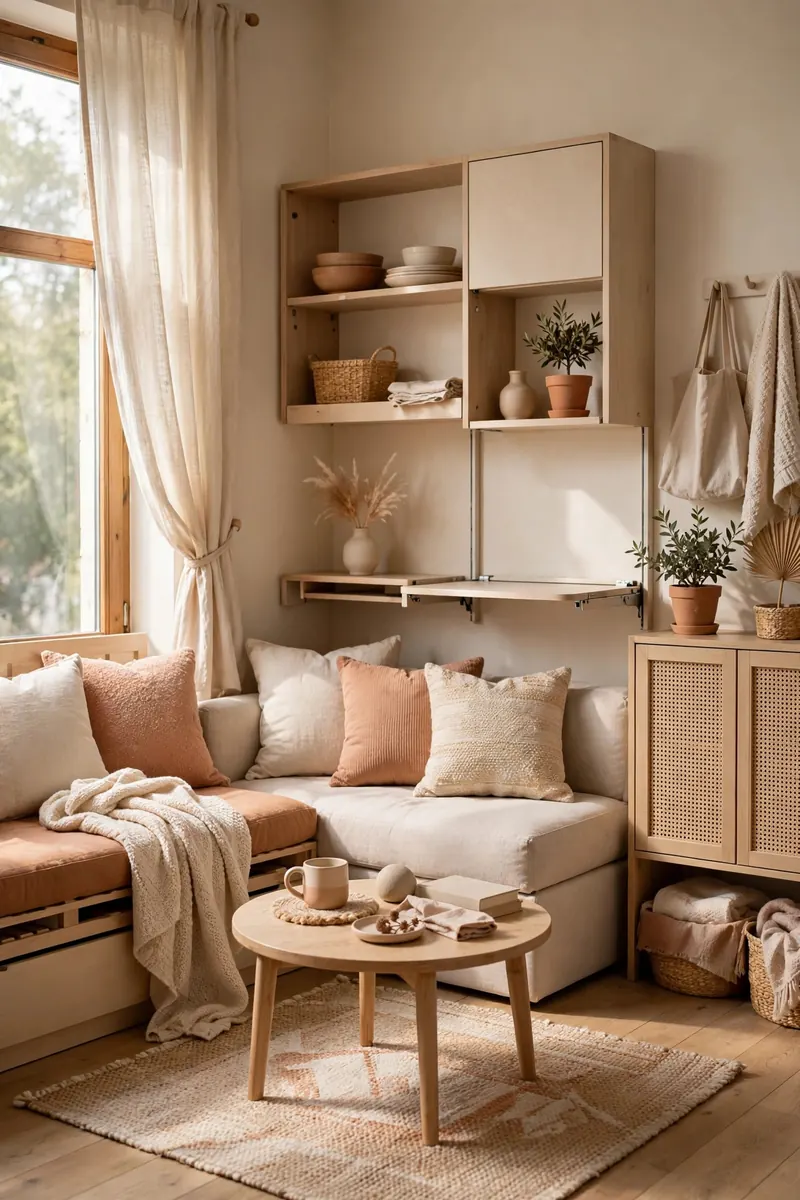
<!-- PINTEREST HERO IMAGE: Vertical 1000x1500 styled cozy window seat nook with a white built-in bench under a large window, a thick sage-green cushion, cream and rust throw pillows, a folded knit blanket, bookshelves flanking both sides, soft morning light, bold text overlay "Window Seat Ideas" -->
The best seat in the house is the one by the window
There's a reason window seats appear in every cozy-home fantasy: natural light for reading, a view for daydreaming, and the particular comfort of being tucked into an alcove while the world goes by outside. In small spaces, a window seat is also ruthlessly practical — it turns dead space under a window (too low for a bookshelf, too awkward for a chair) into seating, storage, and a room's focal point in one build.
You don't need a bay window or a carpenter. A window seat can be a built-in bench, a repurposed dresser, a sturdy bookshelf laid on its side, or even a deep windowsill with the right cushion. What makes it work isn't the construction method — it's the dimensions (seat height and depth that fit human bodies), the comfort layer (a cushion you'll actually sit on for an hour), and the light (positioned for reading, not glare). Get those three right and any window becomes the most fought-over spot in the home.
> *Affiliate disclosure: Roomora is reader-supported. When you buy through links on this page, we may earn an affiliate commission at no extra cost to you.*
Choose your window seat type
1. Build the classic: a bench between bookcases
The iconic window seat is a low bench fitted under the window, flanked by bookcases — and it's iconic because the proportions are perfect. The bench (typically 18 to 24 inches deep, 16 to 20 inches high) anchors the window wall; the bookcases frame it like a proscenium and put reading material within arm's reach. You can build this with stock kitchen base cabinets (24 inches deep, 34.5 inches high — cut down or used as-is with a thick cushion) topped with a plywood seat, flanked by off-the-shelf bookcases.
The honest trade-off: this is a weekend-plus project with real carpentry — leveling, scribing to walls, painting to match. But it's also the version that adds the most value and storage, since the bench interior becomes deep, hidden storage. If you're not ready for cabinet surgery, the same look comes from two tall bookcases with a ready-made storage bench between them — less custom, zero cutting, 80 percent of the effect. Either way, anchor every piece to the wall; a window seat gets climbed on.
2. Repurpose a dresser or credenza as the bench base
A low, wide dresser (28 to 32 inches high is too tall — look for 18 to 22-inch-high credenzas, TV consoles, or toy chests) makes an instant window seat base with zero construction: push it under the window, add a cushion, done. The drawers become the storage — out-of-season clothes, board games, the seasonal supplies from our holiday decor storage ideas — accessible without lifting a heavy hinged top.
Measure carefully: the piece should sit 2 to 4 inches below the windowsill so the cushion doesn't block the window, and its depth should leave the seat at 18 to 22 inches deep including any overhang. The trade-off versus a built-in: a repurposed piece won't be wall-to-wall, so you'll have gaps at the sides — fill them with a narrow bookcase, a floor cushion stack, or a tall plant. For renters, this is the best window seat there is: it moves with you and needs no holes beyond anti-tip anchors.
3. Use a bay or box window's natural alcove
If you have a bay or box window, you already own a window-seat alcove — it just needs a fitted cushion and a base. Measure the alcove's interior at three points (bays are rarely perfectly square) and either order a custom cushion or build a simple plywood platform to square it off, topped with a standard cushion. The platform can be as simple as a 3/4-inch plywood sheet on cleats, painted to match the trim.
The advantage: bay alcoves are naturally the right depth (typically 18 to 24 inches) and the angled sides create the tucked-in feeling people love. The trade-off: custom cushions for odd shapes cost more than rectangular ones — budget accordingly, or square off the alcove with the platform so a standard cushion fits. Add a hinged top to the platform and the entire alcove becomes storage, which in a small home is transformative.
4. Try the no-build version: a deep sill plus a great cushion
Some windows — especially in older homes — have sills 8 to 12 inches deep. That's not a seat, but paired with a thick back cushion against the window and a low ottoman or pouf pulled up in front, it becomes a perch for reading, coffee, and phone-scrolling. Add a sheepskin or folded quilt on the sill for padding and you've spent almost nothing.
Be honest about what this is: a perch, not a lounge. It's perfect for 20-minute sits, not two-hour reading sessions — there's no back support and the depth is wrong for real comfort. But as a zero-commitment test of whether you'd use a window seat, it's invaluable. If you find yourself perching daily, that's your signal to invest in one of the real builds above. This is also the only option for windows where the sill is too high or the wall too thin for a bench.
Get the structure and dimensions right
5. Nail the seat height: 17 to 20 inches finished
Seat height makes or breaks a window seat. Too low (under 16 inches) and getting up requires a grunt; too high (over 21 inches) and feet dangle, which is fine for a bar stool and miserable for reading. The sweet spot is 17 to 20 inches from floor to top of cushion — the same as a dining chair — which lets most adults sit with feet flat and knees at a comfortable angle.
Calculate backwards: decide your cushion thickness first (3 to 4 inches for real comfort, see idea 8), then build or buy the base to put the cushion top at 18 inches. A 15-inch base plus a 3-inch cushion, a 16-inch base plus a 4-inch cushion — the math is simple but everyone forgets it and ends up with a 22-inch seat. For kids' primary use, 14 to 16 inches finished is better; for a household split, 17 inches splits the difference.
6. Depth matters more than you think: 20 to 24 inches
A window seat needs to be deep enough to sit cross-legged or curl sideways — that's the whole point. 20 to 24 inches of seat depth (front edge to wall) fits an adult sitting sideways with knees up; under 18 inches and it's just a bench you perch on facing forward. If your window wall allows, push toward 24 inches — the extra depth is what turns sitting into lounging.
The constraint is the room: a 24-inch-deep seat in a 10-foot-wide bedroom eats 20 percent of the floor width. In tight rooms, 20 inches is the compromise — still curlable for most people, less room lost. Whatever the depth, keep 30 inches of clear floor in front of the seat for walking past and for pulling up an ottoman. A window seat that blocks the room's flow becomes an obstacle, not a nook.
7. Build storage into the base — hinged tops beat drawers here
The space under a window seat is prime hidden storage: deep, accessible, and otherwise wasted. Hinged tops (the whole seat lifts) give you one big cavernous space — perfect for bulky items like spare bedding, seasonal decor, or the board-game collection. Drawers give better organization but cost more to build and waste 2 to 3 inches on slides and framing.
If you go hinged, add soft-close hinges or a lid stay — a plywood-and-cushion lid is heavy enough to slam on fingers, and kids will be opening it. Ventilate the interior slightly (a 1-inch gap at the back or small vent holes) if you're storing textiles, to prevent mustiness. And be realistic about what lives there: the under-seat cavern is for things you need a few times a month, not daily — daily items deserve the accessible systems in our small bedroom ideas.
Comfort: the cushion and textile layer
8. Invest in a 3 to 4-inch foam cushion — it's the whole seat
The cushion is not an accessory; it IS the window seat. A 2-inch pad on plywood feels like plywood within twenty minutes. You want 3 to 4 inches of high-density foam (2.5-pound density or higher — the cheap stuff compresses permanently within months), ideally with a Dacron wrap for a soft crown. For a 24-by-60-inch seat, expect a quality custom cushion to be a real investment — this is the place to spend, because a beautiful bench with a bad cushion never gets used.
The honest trade-off: thick foam plus quality fabric costs more than the bench base in many builds. Mitigate it with a standard-size bench (custom cushions for odd sizes cost 30 to 50 percent more) or a two-piece cushion (two 30-inch cushions are cheaper to replace than one 60-inch). Whatever you choose, get a removable, washable cover — window seats collect sun, dust, and snack crumbs by design.
9. Layer washable textiles: covers, throws, and pillows
A window seat lives in direct sunlight, which fades fabric faster than anywhere else in the home. Choose cushion covers in fade-resistant fabrics (solution-dyed acrylics, or just mid-tone colors that fade gracefully) and keep a washable throw blanket folded on the seat — it protects the cushion, adds warmth for reading, and is the thing guests actually wrap themselves in. Two to three throw pillows in varying sizes create the back support the flat wall doesn't provide.
Pillow math for a 5-foot seat: one 20-inch square Euro, two 16-inch squares, one 12-by-20 lumbar. That's plenty — more becomes a pillow-removal chore every time you sit down. Keep the palette to 2 to 3 colors pulled from the room; the window seat should feel like part of the room, not a separate craft project. Rotate the cushion 180 degrees every few months for even sun exposure and wear.
10. Solve the back-support problem properly
The most common window-seat complaint: there's nothing to lean against. The wall is flat, the window is behind you, and after 30 minutes your back aches. Solutions, in order of effectiveness: a row of firm throw pillows as a backrest (good), a wedge-shaped back cushion custom-made for the seat (better), or flanking the seat with the bookcases from idea 1 so you can lean into the corner (best — corners are nature's backrests).
For serious readers, add a small lumbar pillow at the lower back specifically — it's the missing piece in most setups. And position the seat for side-sitting: most people don't sit facing forward in a window seat; they sit sideways, back against one side, legs stretched along the seat. Design for that — pillows at one end, a small side table at the other for tea — and the ergonomics solve themselves.
Light, styling, and making it yours
11. Layer light for evening reading
Window seats are glorious by day and useless by night without dedicated light. A wall-mounted reading sconce on each flanking bookcase (or one articulating sconce on the wall beside the seat) gives directed light for books without flooding the room. Plug-in sconces with cord covers work for renters; hardwired is cleaner for owned homes. Aim for 2700K warm light — it flatters the cozy brief.
Avoid overhead-only lighting: a ceiling light behind a reader casts their own shadow on the page. The sconce should mount 12 to 18 inches above the seated eye level, slightly to the side of the reading position. A small dimmer (even a plug-in one) lets the nook shift from reading-bright to ambient-glow when the book closes. This is the same layered-light principle that makes small living room layouts feel intentional after dark.
12. Style the flanking space: shelves, art, and plants
The wall space beside and above a window seat is prime styling real estate. Flanking bookcases (idea 1) are the classic, but floating shelves with books and objects, a single piece of art hung above the seat, or a trailing plant on a high shelf all work. Keep the styling low and horizontal near the seat — tall objects beside a window seat compete with the window itself.
One plant is the finishing touch: a trailing pothos on the shelf above, or a small potted plant on the windowsill beside the seat (not in the sitting zone — it'll get knocked over). The honest rule: the window is the art. Everything else is a supporting actor. If your styling starts competing with the view, remove something.
13. Make it a kid's reading nook with their rules
A window seat scaled for kids — 14 to 16 inches high, with washable everything — becomes the reading nook that actually builds readers. Let kids choose the pillows, keep a forward-facing bookshelf (covers out, not spines) within arm's reach, and add a soft rug or floor cushion in front for sprawling. A clip-on book light gives them reading independence after bedtime.
The kid-specific trade-offs: washable covers are non-negotiable (juice happens), hinged lids need soft-close hinges and light lids (finger safety), and the storage underneath becomes toy storage — which means it needs the kid-accessible organization from our toy storage organization ideas, not your overflow. A window seat a child loves is worth more than a playroom they ignore.
14. Adapt it for tiny windows and awkward walls
Not every window fits the classic formula. A narrow window (under 36 inches wide) still takes a seat — just a narrower one, styled as a perch with one great pillow rather than a lounge. A window with a radiator underneath needs clearance: build the seat above the radiator with a vented front (slatted or grille panels) so heat still circulates, or place a freestanding bench in front with 4 inches of air gap.
For windows in bedrooms where the bed already claims the wall, consider the foot-of-bed window: a low bench under it doubles as a window seat when the curtains are open and a luggage bench when they're not. And in a small living room, the window seat can replace an armchair entirely — one less piece of furniture, one more storage cavern, and the best seat in the house.
What not to do with a window seat
Don't build the seat before choosing the cushion. The cushion thickness determines the base height (idea 5), and custom cushions take weeks to arrive. Order or spec the cushion first, then build to fit it — not the other way around.
Don't use low-density foam to save money. Cheap foam compresses permanently within months, and then you have a beautiful bench nobody sits on. High-density foam (2.5-pound or higher) is the difference between a seat and a sculpture.
Don't block the window's operation. The seat shouldn't prevent opening the window for ventilation or block an egress window required by code in bedrooms. Keep the seat below the sill and ensure windows still open — in a bedroom, an egress window blocked by a built-in seat is a code violation and a safety issue.
Don't skip anchoring. Window seats get climbed on, jumped on (by kids), and leaned against. Every freestanding piece — bookcases, dresser bases, benches — gets anti-tip anchored to the wall. This isn't optional.
Don't forget sun protection for the textiles. Direct sun fades and weakens fabric. Fade-resistant covers, a throw blanket as a sacrificial layer, and rotating the cushion are the maintenance that keeps the nook looking good in year three, not just week one.
Frequently asked questions
How deep should a window seat be?
20 to 24 inches from front edge to wall — deep enough for an adult to sit sideways or curl up with knees bent, which is the whole point of a window seat. Under 18 inches it's just a bench you perch on facing forward. In tight rooms, 20 inches is the workable compromise. Always keep 30 inches of clear floor in front for walking past.
What is the best height for a window seat?
17 to 20 inches from floor to top of cushion — the same as a dining chair — so feet rest flat and knees sit at a comfortable angle. Calculate backwards from your cushion thickness: a 3-inch cushion needs a 15-inch base, a 4-inch cushion needs a 14 to 16-inch base. For kids' primary use, 14 to 16 inches finished is better.
How do I make a window seat comfortable for reading?
Four things: a 3 to 4-inch high-density foam cushion (the cheap stuff compresses in months), back support (firm throw pillows, a wedge cushion, or a corner to lean into), a warm reading sconce positioned 12 to 18 inches above eye level to the side, and a small surface nearby for tea. Most people sit sideways in window seats — set up pillows at one end and the side table at the other.
Can I add a window seat as a renter?
Yes — use a freestanding piece as the base: a low credenza, a storage bench, or a toy chest pushed under the window, topped with a thick cushion. It moves with you and needs no construction beyond anti-tip wall anchors (small holes, spackled at move-out). Skip anything built-in or attached to the trim; the repurposed-furniture route gives you 80 percent of the look with zero commitment.
What do you store under a window seat?
Bulky, infrequent-access items: spare bedding, seasonal decor, board games, gift-wrapping supplies. Hinged tops give one big cavern (add soft-close hinges for finger safety); drawers organize better but cost more. Don't store daily-use items there — the lid is heavy and you'll stop opening it. Ventilate slightly if storing textiles to prevent mustiness.
How much does a window seat cost to build?
A no-build version (repurposed dresser + quality cushion) can run a few hundred dollars, with the cushion being the biggest cost. A DIY built-in from stock cabinets and bookcases typically lands in the mid-hundreds plus the cushion. A carpenter-built custom seat runs into the low thousands. In every version, don't economize on the foam — high-density cushion foam is what makes it a seat instead of a sculpture.
Keep going
A window seat is storage, seating, and a room's soul in one project — the same triple-duty thinking behind space-saving furniture for small apartments. If your nook is in the bedroom, our small bedroom ideas show how to balance it with sleep space; in the living room, small living room layout ideas keep the flow working. And for the young readers who'll claim it first, kids' room organization ideas extend the nook logic to their whole room.
Get the Sunday reset: one practical home idea in your inbox every week — subscribe free here. No spam, ever.
Pin title ideas
- 14 Window Seat Ideas for Cozy Reading Nooks in Small Spaces
- How Deep Should a Window Seat Be? (The Real Answer)
- Renter-Friendly Window Seat: No Building Required
- The 3-Inch Cushion Rule for Window Seats That Get Used
- 14 Ways to Turn Any Window Into a Reading Nook