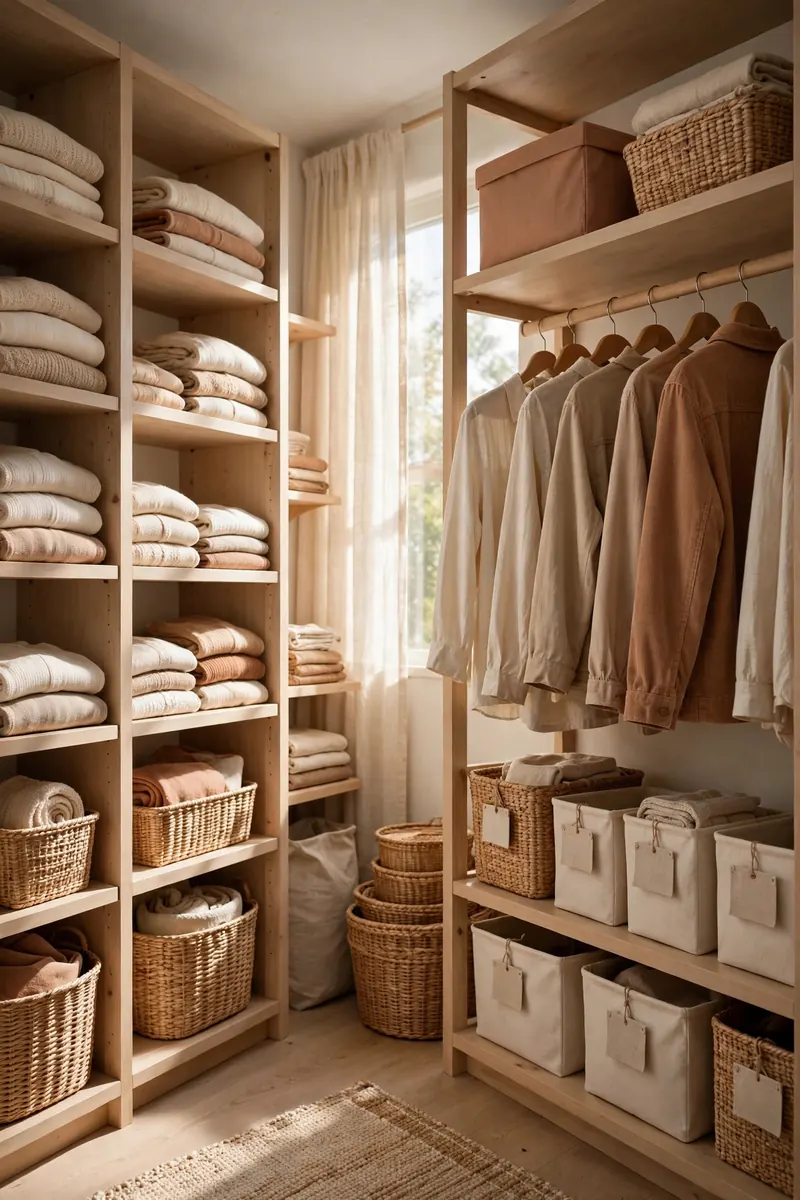
<!-- PINTEREST HERO IMAGE: Vertical 1000x1500 styled small mudroom corner with a wood storage bench and cushion, four coats on brass wall hooks, a boot tray with rain boots, woven baskets in open cubbies, warm afternoon light through a side window, bold text overlay "Mudroom Organization Ideas" -->
Your mudroom is a gear airlock, not a hallway
A mudroom earns its keep at the two busiest moments of the day: everyone leaving and everyone coming home. In a small entryway, one narrow zone — sometimes just 4 by 6 feet of floor — has to absorb coats, shoes, bags, keys, umbrellas, sports equipment, and whatever the weather drags in, twice a day, without becoming a pile. A traditional foyer can afford to be decorative. A mudroom cannot: it's the filter between the mess of the outside world and the calm of the house.
The good news is that mudrooms respond beautifully to systems because the traffic is so predictable. The same people arrive, drop the same categories of gear, at roughly the same time, every day. That means you don't need more square footage — you need assigned homes for each category, at heights each person can reach, with a floor plan that keeps wet stuff off your floors. Everything that follows is built around that: zones first, furniture second, and habits that survive a Tuesday in February.
> *Affiliate disclosure: Roomora is reader-supported. When you buy through links on this page, we may earn an affiliate commission at no extra cost to you.*
Zone the floor before you buy anything
1. Map three zones on paper: wet, dry, and grab-and-go
Before spending anything, sketch your mudroom footprint and divide it into three zones. The wet zone sits closest to the door — this is where boots, wet umbrellas, and rain-soaked jackets land, and it should have a waterproof floor surface or tray. The dry zone is the bench and hook wall: coats, bags, hats, dry shoes. The grab-and-go zone is a shelf or basket near the exit for keys, sunglasses, dog leash, and the mail you're taking with you.
This sounds abstract until you see why it matters: mudrooms fail when wet boots migrate under dry coats and bags pile where boots should be. Zones prevent that by giving every category a physical address. In a hallway-style mudroom as narrow as 3 feet wide, the zones run in a line: door, wet tray, bench with hooks above, grab-and-go shelf by the door frame. Mark the zones with painter's tape on the floor and live with them for a week — if boots keep landing on the "dry" side, move the tray, not the rule.
2. Measure your real usable wall and floor
Tape-measure the wall you plan to use: full width, ceiling height, and any obstructions (door swing arcs, outlets, vents, light switches). A common mistake is buying a 48-inch bench for a 44-inch wall — always subtract 2 inches for fit and another few for anything that swings. Note the door swing: a door that opens into the mudroom steals roughly 9 square feet of usable floor in its arc, which often pushes the boot tray and bench to the opposite wall.
Also measure the people. Adult coat hooks work best at 60 to 65 inches off the floor; kids' hooks at 40 to 44 inches for younger children, 48 to 52 for older ones. A storage bench seat should sit 17 to 19 inches high to be comfortable for sitting while pulling on shoes. Write all of it down — these three numbers (wall width, hook height, seat height) drive nearly every purchase decision below.
The bench: your command center
3. Choose a storage bench that earns its floor space
In a small mudroom, the bench is the single most important piece of furniture, and it should do triple duty: seating for shoe changes, concealed storage for off-season gear, and a landing surface for bags. Open cubbies work best for daily shoes and backpacks (visible, grab-and-go); a lift-top or drawer section handles things you don't need daily — ice scrapers, spare gloves, the umbrella you only use in real rain.
Size rule: the bench should be no deeper than 15 to 17 inches, or it will swallow your walkway. In a 3-foot-wide hallway mudroom, that's the difference between squeezing past and walking normally. Leave at least 30 inches of clear walkway between the bench front and the opposite wall or door swing. If a full bench won't fit, a 24-inch cube ottoman with storage inside and a cushion on top does 80 percent of the job in half the footprint.
4. Add a cushion you can actually sit on daily
An uncushioned wood bench looks crisp in photos and gets avoided in real life — people perch on it sideways or sit on the floor instead, which defeats the shoe-change workflow. A 3- to 4-inch foam cushion with a washable cover turns the bench into the default seat. Choose a cover in a dark, textured fabric: mudroom cushions absorb grime, and pale linen is a maintenance hobby you didn't sign up for.
The honest trade-off: cushions on a lift-top bench can slide around when you open the lid. Solve it with non-slip shelf liner cut to size underneath, or choose a hinged cushion that attaches to the lid. If kids are your primary bench users, consider a cushion with piping — it holds its shape longer under daily abuse than knife-edge cushions.
5. Give every person one cubby or basket
Assign, don't share. One labeled cubby or basket per person — shoes, hat, gloves, the small stuff — is the single change that ends the "where are my gloves" search. Baskets beat open cubbies for small accessories because they contain the sprawl; a cubby full of loose gloves, hats, and scarves becomes a textile swamp within a month.
Label with something durable: engraved tags, chalk labels, or even a strip of painter's tape with a name. The label matters less than the assignment — it turns "the mudroom is messy" into "your cubby needs attention," which is a solvable problem. For a family setup with kids, this pairs naturally with the assignment systems in our kids' room organization guide.
Walls that work harder than the floor
6. Hang coats on individual hooks, not a shared rack
A row of individual hooks at the right height beats a coat rack or a single crowded bar every time. Coats hung on their own hook air out, don't drag on the floor, and can be grabbed one-handed. Space hooks 6 to 8 inches apart for adult coats, 4 to 6 for kids' smaller jackets. Double hooks (two prongs per base) are worth the small premium: coat on the back prong, bag or hat on the front.
Mount hooks into studs or use proper wall anchors rated for at least 25 pounds each — a winter coat plus a loaded backpack routinely exceeds 15 pounds, and a hook that rips out of drywall is a repair job. Stagger two rows on a tall wall: adults' coats at 62 inches, kids' at 42 inches, so shorter arms reach their row without a step stool. For renters who can't drill, heavy-duty adhesive hooks hold daily jackets fine on smooth walls; skip them for loaded backpacks and wet heavy coats, where the honest answer is a freestanding coat rack.
7. Use a pegboard or slatwall panel for sports gear
Sports equipment is the category that breaks most mudrooms: balls roll, rackets poke, helmets vanish. A 2-by-4-foot pegboard or slatwall panel with assorted hooks corrals the awkward shapes — ball bags hang from deep hooks, rackets from double prongs, helmets from single knobs. Mount it in the dry zone, away from the boot tray's splash radius.
The advantage over a shelf is adjustability: as kids' sports change with the seasons, you rearrange hooks instead of buying new furniture. The trade-off is visual — pegboard full of gear looks busy. Keep it contained to one panel and paint it the wall color so the frame disappears; the gear itself provides all the visual noise you need. Overflow equipment that won't fit (skis, large duffels) belongs in the garage, not wedged behind the mudroom door.
8. Put a narrow shelf above the hooks for the grab-and-go layer
A 6- to 8-inch-deep shelf mounted above the coat hooks — roughly 70 to 74 inches high — is prime real estate for the small things that leave the house with you: keys, sunglasses, sunscreen, the dog leash, a small basket for outgoing mail. Shallow is intentional: deep shelves at that height become unreachable junk ledges.
Add small hooks or a rail under the shelf for keys and lanyards so they never sit loose. Keep the shelf contents to a ruthless minimum: if an item hasn't left the house in two weeks, it doesn't belong in grab-and-go. This one shelf, kept honest, eliminates the classic "keys wallet phone" pat-down at the door. If your entry doubles as a mail-sorting spot, the same logic extends to the systems in our entryway organization ideas.
Boot and shoe control
9. Contain every wet shoe on a boot tray with raised edges
A boot tray with a 1- to 2-inch raised lip is non-negotiable in a mudroom that sees rain or snow. Melting snow from one pair of boots can spread across several square feet of floor; the tray catches it, and you empty it instead of mopping. Size the tray to your household's daily shoes — a 30-by-15-inch tray holds two adult pairs comfortably; a family of four often needs two trays or one oversized 36-inch tray.
Choose trays with a textured or ribbed surface so boots don't slide, and a material that tolerates salt and de-icer without staining — rubber or heavy polypropylene beats decorative metal. Empty and wipe the tray weekly in winter; standing meltwater grows a smell you will notice. Place the tray in the wet zone right inside the door, never under the coat hooks — drips from wet coats and melt from boots compounding in one spot is how mudroom floors get damaged.
10. Add a tiered shoe rack for the dry overflow
The boot tray handles today's wet shoes; a tiered rack handles the dry rotation. A two- or three-tier rack against the wall keeps everyday shoes visible and paired, which is what actually gets used — shoes hidden in a closed cabinet in a mudroom get ignored, and then they live on the floor. Keep the rack shallow (10 to 12 inches deep) and low (under 24 inches tall) so it tucks under the coat hooks without blocking them.
Cap the rack at what fits: when the rack is full, something has to leave. This is the physical enforcement of a shoe limit, and it's kinder than a rule nobody follows. Seasonal and occasional shoes live elsewhere — the garage, a hall closet, or under-bed bins — not in the daily mudroom rack. If your rack keeps overflowing, the problem is inventory, not furniture.
Systems that survive real life
11. Run a seasonal rotation box
Mudrooms have a fixed capacity and the weather doesn't. Keep one labeled bin — in the bench, on a high shelf, or just inside the garage — as the seasonal rotation box. In October, winter gear (heavy gloves, scarves, ice scraper, boot dryer inserts) comes out and summer gear (sunscreen, bug spray, pool bag) goes in. Reverse in April. The swap takes twenty minutes and instantly rightsizes the mudroom for the weather you're actually living in.
The discipline is one box per household, not per person — the point is a single swap, not a project. Anything that doesn't fit the box and isn't in daily use gets stored elsewhere until its season returns. This pairs well with a broader seasonal rhythm like the weekly cleaning schedule adapted for entryways: wipe hooks, empty the boot tray, and check the rotation box on the same day each month.
12. Create a "launch pad" basket per adult
Borrowed from family command centers: one small basket per adult on the grab-and-go shelf holding tomorrow's essentials — work badge, gym bag strap, the library books being returned, the permission slip that needs signing. Pack it the night before. Mornings in a small mudroom are a choreography problem, and the launch pad moves the thinking to the evening when you have bandwidth.
Keep baskets small on purpose — a basket big enough for "everything" becomes a junk drawer you carry. One handheld basket, roughly shoebox-sized, forces the nightly triage that makes mornings work. Kids get a simplified version: backpack by the door, packed and zipped, shoes in the tray. No exceptions is the policy; the basket is the tool.
13. Put cleaning supplies where the mess happens
Mudrooms generate a specific, recurring mess — salt lines, muddy paw prints, scuffed floors — and you'll clean it ten times more often if the tools live within arm's reach. A slim caddy hung on the inside of a cabinet door, or a narrow basket on the wall, holding a spray bottle of floor cleaner, microfiber cloths, and a small dustpan and brush means a two-minute wipe-down instead of a postponed chore.
Don't store the full cleaning arsenal here — that's what the under-sink zone is for. The mudroom caddy is a rapid-response kit: floor spray, cloths, brush. Restock it when you do the monthly hook-and-tray wipe-down, and the mudroom never reaches the state that requires a deep clean.
Small-mudroom layout tricks
14. Use the corners and the door backs
In a truly tiny mudroom — a widened hallway, a 3-by-5-foot nook — corners and door backs are free square footage. A corner bench or corner shelf unit uses the dead angle where two walls meet; a triangular corner shelf above hook height holds hats and gloves without touching the walkway. The back of the mudroom door (or the door into the garage) takes an over-the-door hook rail for leashes, reusable bags, and the umbrella — items that are flat, light, and needed at the threshold.
Measure door clearance before adding anything to a door back: the hooks plus hanging items must clear the frame and any adjacent wall when the door swings. Flat-profile hooks (under 2 inches of projection) are the safe choice; deep utility hooks on a door back will gouge the trim on the first enthusiastic swing.
15. Consider a fold-down bench for sub-4-foot spaces
When there's genuinely no room for a permanent bench — a 30-inch-wide hallway, a closet converted to a mudroom — a wall-mounted fold-down bench gives you a seat only when you need it. Mounted at 17 to 19 inches high with brackets rated for at least 250 pounds, it folds flat against the wall when not in use, freeing the full walkway.
The honest trade-off: you lose the storage a bench would have provided, so pair the fold-down seat with wall cubbies or baskets for the storage function. And fold-down hardware needs solid mounting into studs — this is not a drywall-anchor project. For renters, a sturdy folding step stool stored in the corner is the no-holes alternative; it seats one person at a time and tucks away completely.
What not to do in a small mudroom
Don't let it become the overflow closet. The mudroom's fixed capacity is a feature, not a bug — it's the physical limit that forces the seasonal rotation. The moment you add "temporary" storage (the box that didn't fit in the garage, the donation bag waiting for a trip), the zones collapse and the mudroom becomes a hallway with stuff in it. Overflow goes to the garage, the basement, or out the door — never into the mudroom's walkway.
Don't hang hooks above the boot tray. Wet coats drip onto wet boots, and the combined moisture zone rots shoe leather and warps bench wood. Keep the wet landing and the dry hanging in separate wall sections, even if they're only a few feet apart.
Don't choose pretty over washable. Upholstered bench cushions in pale fabric, jute baskets for wet gloves, unsealed wood trays — every one of these looks wonderful for a month and then becomes a maintenance burden or a stain you live with. Mudrooms are utility spaces: washable, wipeable, replaceable finishes are the correct aesthetic.
Don't skip the lighting. A dim mudroom hides the mess until it's a project. If there's no window, a single bright overhead light plus a small motion-sensor light inside the bench or over the hooks changes the space completely — you see the salt line before it sets, and you find the gloves on the first try. Lighting is the cheapest mudroom upgrade there is.
Frequently asked questions
How do you organize a mudroom with no closet?
Lean on the wall: a row of individual hooks for coats, a storage bench with cubbies for shoes and gear, a narrow shelf above the hooks for grab-and-go items, and a boot tray by the door. Without a closet door to hide behind, everything is visible, so use matching baskets and one label system to keep it looking intentional. Renters can do all of this with adhesive hooks and freestanding furniture — no drilling required.
What's the best flooring for a small mudroom?
Something waterproof and easy to mop: luxury vinyl plank, tile, or sealed concrete all work. If you can't change the flooring (renters), a large low-profile waterproof mat under the wet zone plus the boot tray covers 90 percent of the risk. Avoid carpet and unfinished wood in the wet zone — both hold moisture and salt, and both are expensive to remediate.
How many hooks does a family of four need?
Plan two hooks per person minimum: one for the daily coat, one for a bag, hat, or second layer. That's eight hooks for a family of four, spaced 6 to 8 inches apart — roughly 4 feet of wall. Add a few extra at kid height if children are small; you can remove or repurpose them as kids grow. When hooks are full, it's a signal to rotate seasonal items out, not to add more hooks.
How do you keep a mudroom from smelling?
Ventilation and containment. Wet gear needs airflow — don't seal damp boots in a closed bench; use the open tray. Sprinkle baking soda in the boot tray weekly and wipe it out, wash cushion covers monthly in wet seasons, and keep a small lidded trash bin for tissues and dog-waste bags so they don't sit in open baskets. If sports gear is the culprit, it may need to live in the garage with better airflow.
What's the difference between a mudroom and an entryway?
A mudroom is a utility zone built for dirty gear: waterproof surfaces, boot storage, heavy-duty hooks, and systems for wet and seasonal items. An entryway or foyer is the home's welcome space: decorative, with seating, mirrors, and console styling. Many homes blend the two, but organizing them works better when you decide which job each square foot is doing — our entryway organization ideas cover the decorative side.
Can you make a mudroom in a hallway or under the stairs?
Yes — a 3-foot-wide hallway section or an under-stair nook works with a slim bench (15 inches deep), wall hooks, and a boot tray. Under stairs, watch the ceiling height: you need at least 6 feet of clearance where people stand to put on shoes, and sloped ceilings are fine for low cubbies and the boot tray. Keep the walkway clear at 30 inches minimum so the "mudroom" doesn't block the hallway's actual job.
Keep going
A mudroom is one node in a whole-house organization system. Extend the same zone logic to the laundry room where wet gear gets washed, push overflow sports equipment to the garage, and keep the decorative side of your entrance working with entryway organization ideas. When the mudroom is dialed in, the weekly cleaning schedule keeps it there with ten minutes of maintenance.
Get the Sunday reset: one practical home idea in your inbox every week — subscribe free here. No spam, ever.
Pin title ideas
- 15 Mudroom Organization Ideas for Small Entryways That Actually Work
- Small Mudroom? This Boot Tray + Hook Layout Fixes Everything
- The Mudroom Zone System: Wet, Dry, Grab-and-Go Explained
- 15 Ways to Organize a Tiny Mudroom (No Closet Needed)
- Mudroom Organization Ideas Renters Can Do Without Drilling