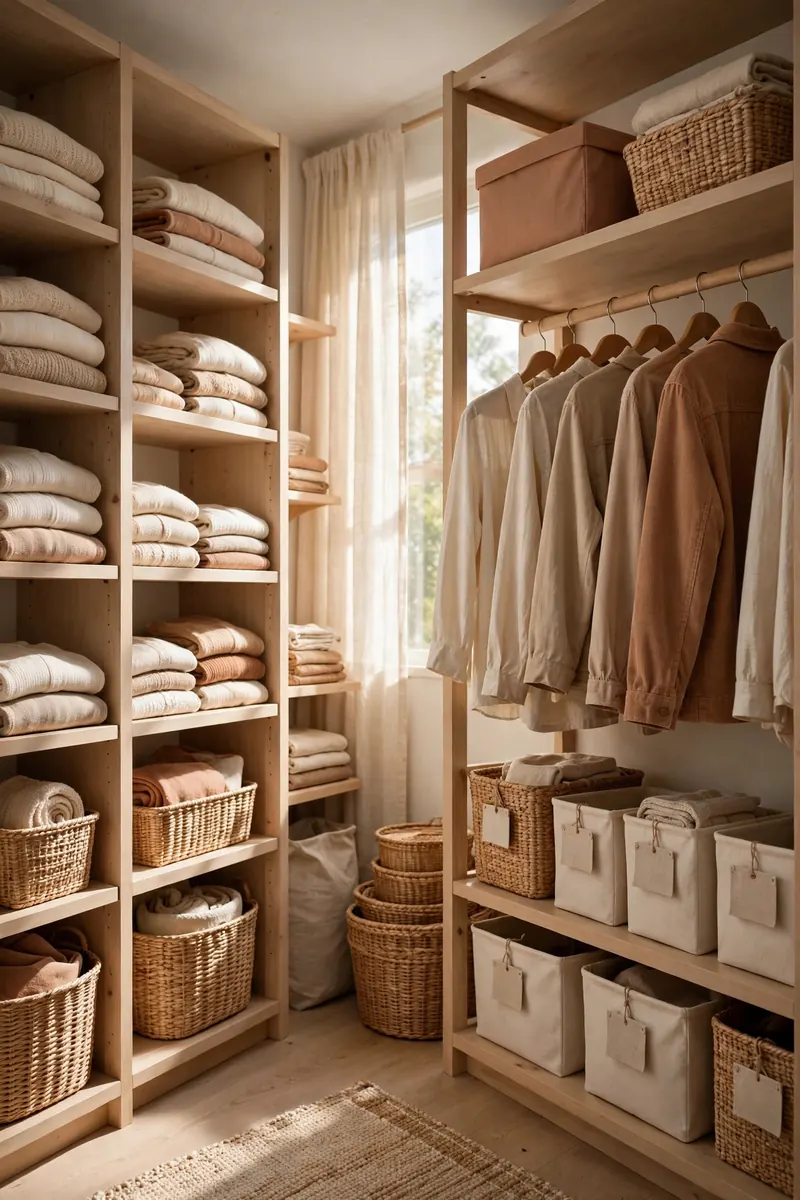
<!-- PINTEREST HERO IMAGE: Vertical 1000x1500 open tiny coat closet interior with double chrome hanging rods of neatly spaced coats, labeled fabric bins on the top shelf, boots lined on a tray below, warm hallway light spilling in, bold text overlay "Coat Closet Organization Ideas" -->
The smallest closet with the biggest job
A coat closet is usually the tiniest closet in the house — often just 24 to 36 inches wide and 24 inches deep — yet it has to hold the bulkiest items you own: winter coats, boots, umbrellas, bags, and the guest overflow when people come over. Unlike a bedroom closet, where clothes are thin and uniform, a coat closet deals in puffy, heavy, irregular shapes that fight every inch of the space.
That's exactly why coat closets respond so well to interior upgrades. The box is small enough that one afternoon of work — a second rod, better shelf bins, hooks on the side walls, storage on the door — can genuinely double its capacity. The enemy isn't the size; it's the default setup most closets come with: a single rod at 66 inches, one shelf above it, and a dark floor where boots go to be forgotten. Everything below rebuilds that interior piece by piece, with measurements that fit real tiny closets.
> *Affiliate disclosure: Roomora is reader-supported. When you buy through links on this page, we may earn an affiliate commission at no extra cost to you.*
Measure the box before you rebuild it
1. Record the three numbers that decide everything
Measure the interior width wall to wall, the interior depth front to back, and the height from the floor to the existing shelf (or ceiling). A typical reach-in coat closet is 24 inches deep — exactly enough for a coat on a hanger, which needs about 22 to 24 inches front to back. If your closet is shallower than 22 inches, standard hangers will cram against the door, and you'll need slim velvet hangers (about 17 inches wide) or a hook-based system instead.
Also note what's around the closet: a hinged door that swings out steals hallway space but gives you full access; bifold or sliding doors give you access to only half the closet at a time, which changes how you zone the interior. Photograph the empty closet with the tape measure visible — you'll reference it when buying rods, bins, and hooks, and it stops the classic mistake of buying a 36-inch rod for a 30-inch closet.
2. Check what the walls and shelf can actually hold
Coat closets carry serious weight: a loaded winter coat can weigh 5 to 8 pounds, and a rod of six of them plus bags easily exceeds 50 pounds. Before adding a second rod or heavy shelf brackets, find the studs with a stud finder or the knock test — rods and shelf brackets should anchor into studs or solid blocking, not drywall alone. The existing shelf in many closets is a single wire shelf rated for light storage; if you plan to stack bins of off-season gear on it, reinforce it with brackets into studs first.
Renters: tension rods are the no-holes answer for a second hanging rod, and they hold daily coats fine when sized correctly (measure twice — a tension rod 2 inches too short will slip under load). Adhesive hooks work on smooth closet walls for light items like scarves and leashes, but skip them for heavy coats. Our renter-friendly apartment decor ideas cover more no-drill upgrades in the same spirit.
Double the hanging space
3. Add a second rod for the double-hang
The single highest-impact upgrade in a tiny coat closet is a second rod. Mount one rod high (around 78 to 80 inches) for long coats and a second rod low (around 40 to 42 inches) for short jackets, kids' coats, and bags on hangers. Two rods in a standard 7-foot-tall closet effectively double hanging capacity without touching the footprint.
Height math matters: a long winter coat needs roughly 50 to 54 inches of hanging clearance from rod to floor, so the high rod must sit at least that high above the floor — in a closet with 84 inches of interior height, an 80-inch rod leaves 80 inches below it, plenty. The low rod at 40 inches gives 40 inches of clearance — right for hip-length jackets and children's coats, which run 24 to 32 inches long. Keep heavy coats on the high rod only if it's anchored into studs; the low rod, closer to its brackets' base, often carries weight more stably.
4. Use slim hangers and give coats breathing room
Bulky plastic or wooden hangers eat 2 to 3 inches of rod each; slim velvet or thin metal hangers use about half an inch. In a 30-inch-wide closet, switching hangers can free space for three to four more coats — the cheapest capacity upgrade there is. Velvet hangers have a second benefit: coats don't slide off them, which matters when you're cramming puffy sleeves together.
Still, don't pack the rod wall to wall. Coats need a little air to dry between wearings, and a rod packed so tight you can't slide a hanger is a rod you'll stop using — the daily coat migrates to a chair instead. Leave 10 to 15 percent of each rod empty as working space. When both rods are full, that's the signal for the seasonal rotation, not for a third rod.
5. Hang bags and odd shapes on the rod ends
The 3 to 4 inches of rod at each end — inside the side walls — is awkward for hangers but perfect for S-hooks holding tote bags, umbrellas, the dog leash, and reusable shopping bags. S-hooks on a closet rod are the cheapest organizer in this entire article and one of the most used: everything hangs visible, grabbable, and off the floor.
Keep it to lightweight items here; heavy bags on S-hooks slide toward the middle and bunch the coats. One umbrella, one leash, two totes per end is the working limit. If bags are a whole category in your house, they may deserve their own wall hooks — the logic overlaps with the drop-zone thinking in our entryway organization ideas.
Shelves that work harder
6. Turn the top shelf into labeled bin storage
The shelf above the high rod — usually around 80 to 84 inches — is deep, dark, and hard to reach, which is why it becomes a graveyard of mystery boxes. Fix it with bins you can identify from below: fabric bins with large label holders on the front face, one category per bin — "winter accessories," "guest linens," "off-season hats." Because you can't see into them from the floor, the label is load-bearing; unlabeled bins on a high shelf get forgotten within a season.
Choose bins that fit the shelf depth with an inch to spare — a 24-inch-deep shelf takes 22-inch bins comfortably. Keep the total weight reasonable: high shelves anchored only to drywall can bow under heavy bins, so reserve this shelf for light, bulky items (hats, scarves, spare tote bags) and put anything heavy lower. A small folding step stool stored beside the closet makes the seasonal swap safe; reaching overhead with a heavy bin is how closets and people get hurt.
7. Add a half-depth shelf for the short-coat side
If your closet has a double-rod setup with short jackets on the low rod, the space above those jackets — between about 45 and 75 inches on that side — is dead air. A half-depth shelf (10 to 12 inches deep) mounted on the side wall above the short coats captures it for folded items: gloves, scarves, beanies, the small accessories that otherwise live in a pile on the closet floor.
Half-depth is deliberate: a full-depth shelf here would block access to the coats below. Mount it on the side wall rather than spanning the closet so the coats still slide freely. This is also the ideal spot for a small basket per person for winter accessories — the same assignment logic as the mudroom drop zones, miniaturized for the closet.
8. Install a shoe shelf just above the floor
Boots and shoes on the closet floor become a scuffed pile where pairs separate. A single low shelf — a simple board on brackets 6 to 8 inches off the floor — lifts everyday shoes into a visible row and leaves the floor beneath it for tall boots standing upright. One shelf, one row, everything visible: that's the whole system.
Measure your tallest boot before setting the shelf height; knee-high boots need 16 to 18 inches of clearance. If tall boots are the main residents, skip the low shelf and use a boot tray on the floor instead — boots standing in a tray with a raised lip stay paired and contain the melt. Either way, cap the closet's shoe inventory at what the shelf or tray holds; overflow shoes belong in the bedroom or under the bed, not wedged behind the coats.
The door is free real estate
9. Mount an over-the-door hook rail or rack
The inside of the closet door is roughly 6 square feet of unused storage in a tiny closet. An over-the-door hook rail — no screws needed — holds the daily coat, tomorrow's jacket, the umbrella, and the bag that's leaving with you in the morning. In a household where one person's gear does 80 percent of the daily traffic, the door rail can be their entire station, leaving the rods for everyone else.
Check two things before buying: the gap between the door top and the frame (most over-door hooks need about a quarter inch of clearance — tight weatherstripping can block them), and the swing arc — items hanging on the door must clear the closet's side wall and any shelving when the door closes. Flat-profile hooks keep the closed door flush; deep hooks on a door that closes against a narrow closet will jam.
10. Use the door back for flat storage: scarves, belts, shoe pockets
A clear over-the-door shoe organizer — the pocket kind — is one of the highest-density storage tools for a coat closet door: each pocket holds gloves, hats, scarves, sunglasses, sunscreen, the spare house key. Twenty-plus pockets on a door back absorb the entire small-accessories category that otherwise fills the shelf and floor.
The honest trade-off is visual: a pocket organizer full of stuff looks busy when the door is open. Choose one in a neutral color, keep the pockets assigned (one row per person or per category), and purge it during the seasonal swap — pocket organizers are where single gloves go to retire. For bifold or sliding doors where over-the-door hooks don't fit, adhesive-mounted pocket panels on the flat door face do the same job.
Hooks on the side walls
11. Add interior side-wall hooks for the daily rotation
The side walls inside a coat closet — the 24-inch-deep returns on each side — are usually bare. Two to four sturdy hooks per side wall hold the items in active rotation: today's coat, the dog leash, a hat, the umbrella. Side-wall hooks keep the daily items off the rods entirely, which means the rods stay organized for the full collection instead of being churned twice a day.
Mount hooks at 60 to 65 inches for adults, lower on one side for kids. Because side walls are close to the door frame, use hooks with a low profile (under 3 inches of projection) so hanging items don't block the door from closing. Anchor into studs where possible — side walls take the same heavy-coat loads as any other hook, and a hook that pulls out inside a closet is discovered at the worst moment.
12. Hang a small mirror on the inside of the door
This isn't storage, but it earns its place: a full-length mirror on the inside of the closet door turns the coat closet into the last-check station — coat on, mirror check, out the door. In homes where the coat closet sits by the front door, it replaces a separate hallway mirror and saves that wall space for something else.
Use an over-the-door mirror mount or adhesive mirror tiles rated for doors; a leaning mirror inside a 24-inch-deep closet wastes the floor. Keep it simple and shatter-safe — a lightweight acrylic mirror is the practical choice where kids slam doors.
Keep it under control
13. Enforce one-in, one-out for coats
A tiny coat closet has a fixed capacity, and coats are the category most likely to exceed it — the old puffer stays "just in case," the event coat from three years ago, the one with the broken zipper awaiting repair. The rule that actually works: every new coat that enters the closet means one leaves — donated, relocated to bedroom storage, or repaired within the week.
Do the count twice a year at the seasonal swap: pull every coat out, try on the questionable ones, and be honest about the repair pile. A broken zipper that hasn't been fixed in a year is a donation. This single habit does more for a tiny coat closet than any organizer, because organizers can't fix inventory. The same discipline scales to the whole house with a room-by-room declutter routine.
14. Run a seasonal swap with one labeled bin
Keep one bin — on the top shelf, in the bedroom, or just inside the garage — as the off-season coat holding pen. In spring, heavy winter coats, snow boots, and the deep-winter accessories go into the bin; in fall, they come back and the light rain jackets rotate out. The swap takes thirty minutes and instantly rightsizes the closet for the weather you're living in.
Label the bin by season, not by contents ("Winter coats 2026" beats "coats"), so future-you knows what's inside without opening it. Store the bin somewhere dry — a garage that floods or a damp basement will ruin down and leather over a season. If your climate has real winters, this bin is also where the boot dryer inserts and spare gloves live between seasons.
What not to do in a tiny coat closet
Don't store cleaning supplies or paint here. Coat closets sit by the front door and get opened constantly — they're terrible homes for chemicals, which belong in a ventilated, latched space like the under-sink zone or garage. The fumes, the spill risk near coats, the kid access: none of it is worth the convenience.
Don't use the floor as a shelf. The closet floor is the landing zone for boots and the step-in area for reaching the back — every box stored on it blocks access to everything behind it. If the floor is full, the closet is full; that's the signal to rotate, not to stack higher.
Don't install a rod you can't reach. A high rod at 80 inches is useless if the shortest daily user can't reach it without a stool — they'll hang their coat on the doorknob instead, and the system breaks. Match rod heights to the people who use them, even if it means the "optimal" double-hang becomes a single rod plus hooks.
Don't forget the light. Most coat closets are dark boxes, and a dark closet is a closet you avoid organizing. A battery-powered motion-sensor light — the stick-on kind — costs little and changes everything: you can see the back wall, read the bin labels, and find the matching glove. Install it before the organizers, not after.
Frequently asked questions
How do you organize a very small coat closet with no shelves?
Start with what needs no installation: slim hangers on the existing rod, S-hooks on the rod ends for bags, an over-the-door hook rail, and a boot tray on the floor. That alone doubles usable storage. Then add one anchored upgrade — a second tension rod or a half-depth side shelf — once you've lived with the layout. Renters can do the entire first stage with zero holes.
What's the best way to store boots in a coat closet?
Stand tall boots upright in a boot tray with a raised lip on the closet floor — the tray contains melt and salt and keeps pairs together. Use boot shapers or rolled magazines inside tall boots so they don't slump and crease. Short boots and shoes go on a low shelf above the tray or in a single row beside it. Off-season boots move to the seasonal bin, not the closet floor.
How many coats should a small coat closet hold?
A 30-inch-wide closet with a double rod comfortably holds 10 to 14 coats on slim hangers with working space; a single-rod closet holds 6 to 8. Count yours: if you're forcing hangers or coats are compressed flat, you're over capacity and the seasonal swap plus one-in-one-out rule will do more than any product. Guest coats need 2 to 3 empty hangers held in reserve — don't fill the closet to 100 percent.
Can you put a coat closet system in a rental?
Yes — tension rods for the second hanging rod, over-the-door hooks and pocket organizers, freestanding boot trays, adhesive hooks on smooth walls for light items, and a battery motion light. The only thing to skip is drilling shelf brackets and heavy rods into walls you can't repair. Keep the landlord's original rod and shelf intact so move-out is a thirty-minute reversal.
How do you keep a coat closet from smelling musty?
Airflow and dryness. Don't pack coats so tightly air can't move, wipe the boot tray weekly in wet seasons, and never store damp coats sealed in the closet — let them air on a hook first. A small moisture absorber on the top shelf helps in humid climates, and cedar blocks or rings on the rod deter moths from wool coats. If the closet shares a wall with a bathroom, check for plumbing moisture before blaming the coats.
Should winter accessories live in the coat closet or the bedroom?
Daily winter accessories — the gloves, hat, and scarf in active use — belong in the coat closet, in a per-person basket or door pocket, because that's where the coat is. The spares and off-season sets belong in the seasonal bin elsewhere. Splitting it this way keeps the closet's accessory storage to one small zone instead of a drawer-sized sprawl.
Keep going
The coat closet is the interior engine of your entryway system. Pair it with the zone logic of mudroom organization ideas if your home has a dedicated drop zone, keep the decorative side welcoming with entryway organization ideas, and push off-season overflow to under-bed storage or the garage. When the seasons turn, the holiday decor storage guide keeps the top shelf honest.
Get the Sunday reset: one practical home idea in your inbox every week — subscribe free here. No spam, ever.
Pin title ideas
- 12 Coat Closet Organization Ideas for Tiny Closets
- Tiny Coat Closet? This Double-Rod Trick Doubles Your Space
- Small Hallway Closet Organization Ideas That Actually Fit
- 12 Ways to Organize a Coat Closet With No Shelves (Renters Too)
- The One-In-One-Out Rule That Fixes Overstuffed Coat Closets