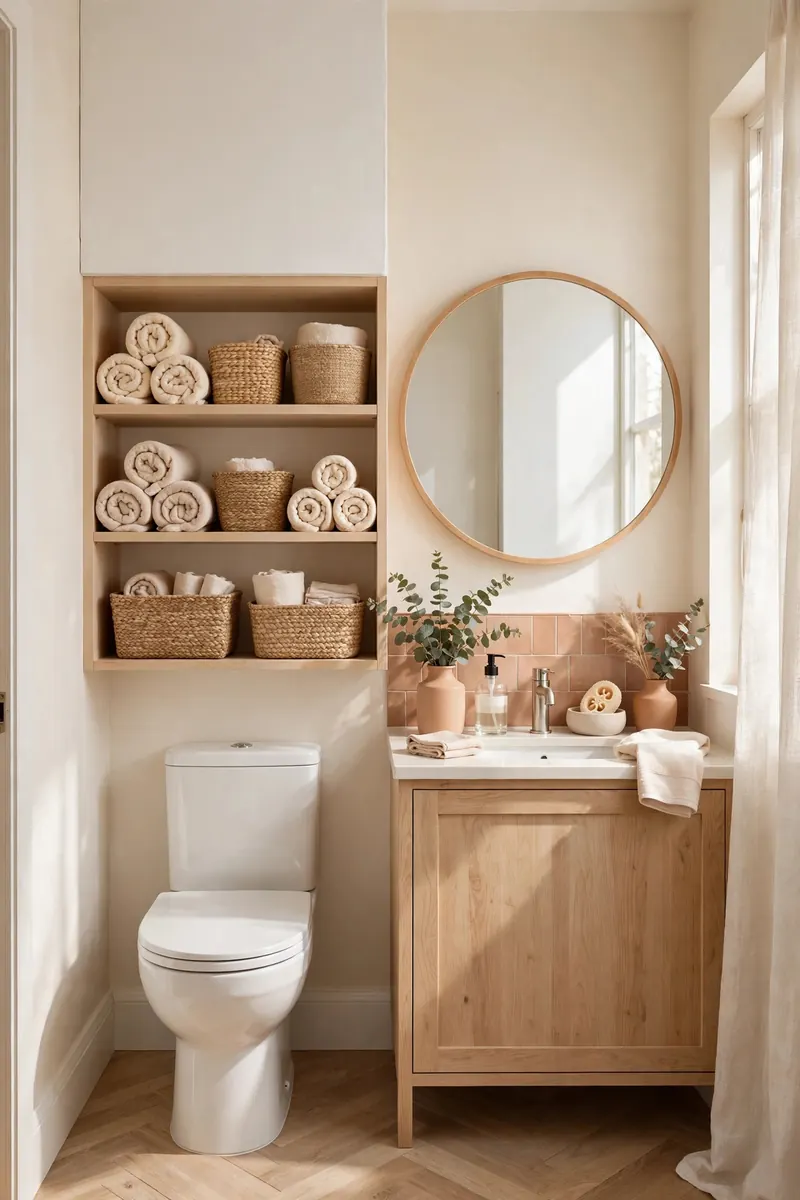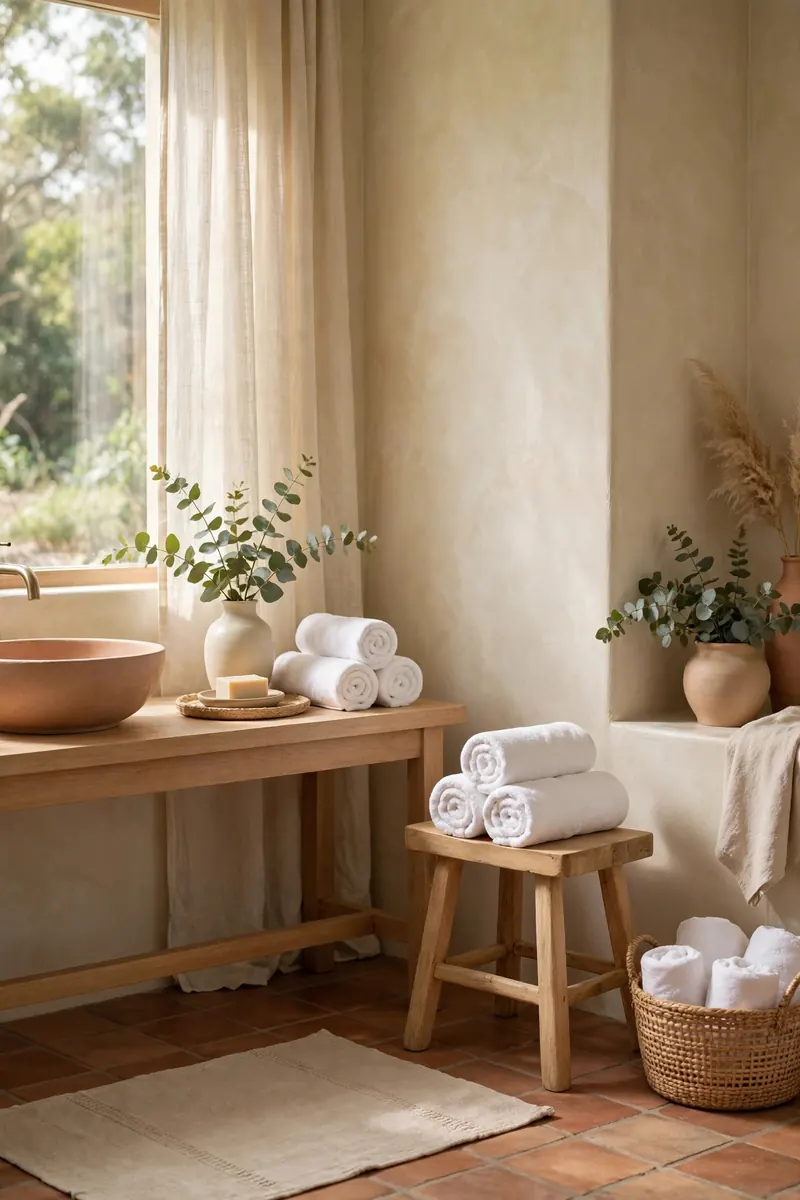
<!-- PINTEREST HERO IMAGE: Vertical 1000x1500 bright bathroom scene with three styled open wooden shelves above a white vanity — rolled white towels, amber glass soap dispensers, a trailing green pothos plant, a woven basket, and a small framed print — soft natural window light, clean spa-like palette, bold text overlay "Pretty + Practical Shelf Ideas" -->
The bathroom shelf balancing act
Open bathroom shelves are asked to do two jobs at once: hold the things you reach for every morning, and look like you thought about them. The trick is that most shelf styling advice forgets the bathroom's actual conditions — steam, splashes, and humidity swings that warp wood, rust metal, and turn pretty paper goods into sad pulp within months.
Get it right and a set of shelves above the toilet or beside the vanity becomes the hardest-working decor in the house. The numbers matter more here than in any other room: shelf depth of 8 to 10 inches fits rolled towels and standard bottles without things teetering on the edge; 12 to 18 inches of vertical clearance between shelves lets you actually remove a tall shampoo bottle without knocking the shelf above; and anything within about 5 feet of the shower head lives in the "splash zone," where only truly waterproof decor survives. The ideas below respect those constraints while keeping the pretty intact.
> *Affiliate disclosure: Roomora is reader-supported. When you buy through links on this page, we may earn an affiliate commission at no extra cost to you.*
Ground rules before you style anything
1. Respect the humidity zones
Not every shelf in a bathroom faces the same conditions. Map yours: the splash zone (within roughly 5 feet of the shower or tub) gets waterproof-only styling — sealed glass, ceramic, stone, and plastic plants. The steam zone (the rest of the room, especially near the door and ceiling where vapor collects) allows most decor but rules out anything that hates moisture: untreated paper, cardboard boxes, raw wood frames, and iron or unsealed steel that rusts. The dry zone — a shelf in a large bathroom far from water, or anything inside a well-ventilated half-bath — behaves like any other room.
When in doubt, assume steam zone. Bathrooms without a window or with a weak exhaust fan stay humid for 30 to 60 minutes after a shower, and that adds up to real damage on the wrong materials over a year. If your mirror fogs, your decor is fogging too.
2. Use the 60/40 rule: practical first, pretty second
A bathroom shelf that is 100 percent decor is a styling prop in a room where you need storage. Aim for roughly 60 percent practical (towels, soap, everyday bottles) and 40 percent decorative (plants, art, candles, texture). The practical items are doing double duty anyway — a stack of crisp white towels is genuinely decorative, and amber glass dispensers look better than any product bottle.
This ratio also protects you from the most common shelf failure: the shelf that slowly fills with daily junk until it looks worse than bare wall. When the practical slots are full and assigned, everything new has nowhere to go except back where it belongs. For the broader system behind keeping bathroom storage assigned, our small bathroom storage ideas walk through the zones approach.
Shelf-by-shelf styling ideas
3. Roll towels like a spa, not like a suitcase
Rolled towels are the single best-looking practical item for bathroom shelves, and they earn it: a tight roll shows off the towel's texture, fits narrow shelves, and lets you grab one without disturbing the stack. Standard bath towels roll to roughly 6 to 8 inches wide, which fits a 10-inch-deep shelf with room to spare. Hand towels roll to about 4 inches — tuck them in front of or beside the bath towels for a graduated look.
Keep rolls uniform: same color family, same fold length, same tightness. Three to five rolls per shelf reads full without cramming. The trade-off is honest: rolled towels use more horizontal space than folded stacks, so on narrow shelves (under 20 inches wide) fold instead — a folded stack of three towels is about 10 by 14 inches and nearly as pretty.
4. Decant soaps and lotions into matching dispensers
Nothing kills shelf aesthetics faster than a row of clashing product labels. Decanting hand soap, lotion, and even shampoo into matching glass or ceramic dispensers is the highest-impact styling move in the bathroom. Amber glass bottles are the classic choice — they look good, hide fill levels, and the glass survives humidity fine. Frosted or ceramic pump bottles work equally well and chip less.
Buy dispensers with the pump style you'll actually maintain: a pump that clogs in hard-water areas becomes a chore you resent. And keep one original bottle stored out of sight (in your under-sink zone) with the ingredient list, in case of skin reactions. Decanting is styling; the original label is information.
5. Corral the small stuff on trays
A tray is the stylist's container for the bathroom: it turns five unrelated items into one intentional vignette and gives small things (perfume, a ring dish, a reed diffuser) a defined home so they don't migrate. On a shelf, a tray 10 to 14 inches wide anchors a whole section. Wood trays look warm but need sealing for steam zones — lacquered bamboo or acacia with a food-safe oil finish holds up well. Marble, ceramic, or metal trays with a powder-coated finish are the zero-maintenance options.
One tray per shelf is the limit; two trays side by side read as clutter with a frame. And whatever lives on the tray should survive being wiped down — bathroom trays collect dust and product film, and a wipeable surface makes the weekly cleaning routine painless.
6. Add greenery that actually survives a bathroom
Plants are the fastest way to make bathroom shelves feel alive, and bathrooms suit more plants than people think — the humidity is a feature, not a bug, for tropical varieties. Pothos is the workhorse: it tolerates low light, thrives in humidity, and trails beautifully off a shelf edge. Boston ferns, spider plants, and ZZ plants (for darker bathrooms) are similarly forgiving. A 4- to 6-inch pot is the sweet spot for shelf scale.
Two honest caveats. First, "low light tolerant" does not mean "no light" — a windowless bathroom needs a plant you rotate out weekly or a good faux plant, full stop. Second, pots need saucers or cachepots on shelves; water stains on wood shelving are permanent. High-quality faux plants are a legitimate choice in windowless bathrooms and directly over the toilet (splash zone). If you go faux, buy one good plant rather than three cheap ones — plastic shine is what gives them away, and good ones photograph and read convincingly.
7. Hide the ugly in beautiful baskets
Every bathroom has items that must be accessible but shouldn't be visible: extra toilet paper, cleaning wipes, the backup shampoo, feminine products. A lidded woven basket or a fabric bin on the shelf swallows all of it. Seagrass, water hyacinth, and rattan handle bathroom humidity far better than untreated wicker or fabric bins, which can mildew in steamy rooms.
Size the basket to its contents, not the shelf: a basket that's half-empty on a shelf looks like you gave up. For toilet paper storage specifically, a lidded basket holding 4 to 6 rolls is the practical standard for a household of two. Label the basket only if guests use the bathroom — otherwise, you know what's in it.
8. Use apothecary jars for the pretty consumables
Cotton balls, cotton swabs, bath salts, and Epsom salt look genuinely good in sealed glass jars — and the seal matters, because humidity turns cotton products limp and clumps bath salts. Choose jars with gasket seals or screw tops, not open canisters. A set of two or three jars in graduated heights (roughly 6, 8, and 10 inches tall) makes a classic shelf grouping.
Refill them from bulk packages stored elsewhere; the jar is display, not primary storage. And keep them out of the splash zone — sealed or not, water spots on glass need constant wiping, which is a maintenance tax you don't need. Pair this with the zone logic in our bathroom vanity organization guide so display and daily-use storage don't fight.
9. Layer scent safely: diffusers over candles
Scent makes a bathroom feel finished, but open flames on a crowded shelf are a bad trade. Reed diffusers are the shelf-safe default — no flame, no wax, months of runtime, and the bottle itself is decor. Place the diffuser toward the back of the shelf so the reeds don't get knocked, and flip the reeds weekly for stronger scent.
If you love candles, use them as decor only: a lidded candle (unlit) in a pretty vessel gives you the look with zero fire risk, or use a flameless LED candle for evening glow. Never leave a real candle burning on a shelf near towels or curtains, and never on a shelf above the toilet where it's out of sight and reach.
10. Style the above-toilet shelf at eye level
The shelf above the toilet is usually the most visible shelf in the bathroom, so treat it like a mantel: one hero arrangement at eye level, supporting items around it. The hero is typically a plant, a framed print, or a sculptural object (a stone bowl, a ceramic vase). Flank it with the practical: folded towels on one side, a lidded basket on the other.
Mind the clearance: the shelf should sit high enough that nobody hits their head — at least 24 inches above the tank lid for the bottom shelf. And skip anything fragile, top-heavy, or unsealed directly above the toilet; gravity plus plumbing plus guests is not the combination for your favorite ceramic.
11. Give guests their own shelf moment
If guests use this bathroom, dedicate one small section as the hospitality zone: a folded hand towel, a fresh bar of soap or a pump bottle, and a tiny basket with the things guests forget — a spare toothbrush, toothpaste, a razor, pain reliever. It's hotel thinking, and it costs almost nothing once set up.
Keep it compact — one tray or one 12-inch section — and refresh it quarterly. Expired or dusty guest supplies are worse than none. This is also the one spot where a small framed note or a sprig of eucalyptus in a bud vase earns its keep: it signals "this is for you" without a word.
12. Add art that can handle steam
Bare walls between shelves beg for art, but bathroom art needs to be humidity-proof. Framed prints under glass or acrylic survive steam zones well — the glazing is the protection, so make sure the frame seals reasonably and the back isn't raw cardboard. Canvas prints without glass, wood frames without sealing, and anything on plain paper will cockle, spot, or grow mildew within a year in a steamy bathroom.
Small is fine: 5-by-7 or 8-by-10 prints in slim frames suit shelf-top leaning, and leaning (rather than hanging) lets you swap art seasonally. Keep art out of the direct splash zone. For renter-friendly ways to hang or lean art without drilling, our renter-friendly apartment decor ideas cover damage-free options.
13. Use the underside: hooks and small rails
The shelf itself is only half the real estate. A slim rail or a row of adhesive hooks under the lowest shelf holds hand towels, a washcloth, or a hanging plant at zero shelf footprint. This is the highest-value trick for tiny bathrooms: it adds storage without adding shelf depth, and hanging items stay ventilated (good for damp towels).
Adhesive hooks rated for 3 to 5 pounds hold towels reliably on smooth tile or painted drywall; check the weight rating and surface compatibility before buying, and skip them on textured or wallpapered walls. In a rental, they're the entire strategy — no holes, full function.
14. Light it like you mean it
Bathrooms are often the worst-lit room for shelf styling — a single overhead light flattens everything. A small LED puck light or a battery-powered picture light above or under the shelves adds the warm glow that makes styled shelves look styled. Warm white (2700K to 3000K) flatters skin tones and wood; cool white makes a bathroom feel clinical.
Battery puck lights with motion sensors are the low-commitment option: stick them under the shelf, and they light up when someone enters. Rechargeable ones beat disposable-battery ones on running cost. The trade-off: you'll recharge them every few weeks with daily use, so buy a two-pack and rotate.
What not to do: bathroom shelf mistakes
Don't style with paper. Paperback books, unsealed prints, cardboard boxes, and paper-wrapped soaps absorb humidity and look tired within months. If you love the book-on-the-shelf look, use one sealed decorative book box instead.
Don't put unsealed metal in the steam zone. Iron, raw steel, and cheap "antique finish" decor rust. If you love the look, choose powder-coated, stainless, or sealed finishes — and check the underside, where manufacturers cheap out on coating.
Don't overload floating shelves. Bathroom shelves hold heavy things — full bottles, stacks of towels, jars of bath salts. A shelf rated for decor weight will sag or pull out of drywall under a gallon of product. If you're installing new shelves, anchor into studs or use proper drywall anchors rated well above your expected load; the bracket and weight-limit details are in our DIY floating shelf guide.
Don't display what you use messily. Open makeup palettes, toothbrushes in the open, and half-used product bottles belong behind a door or in a drawer. The shelf shows the decanted, the sealed, and the spare — daily-use mess lives in the vanity where it belongs.
Don't forget the cleaning tax. Every object on a bathroom shelf collects a film of dust, hairspray, and humidity residue. Before adding the tenth decorative item, ask: "Will I dust this monthly?" If the answer is no, it doesn't go on the shelf. Fewer, larger items beat many small ones — they're faster to lift and wipe under.
Don't block the ventilation. Shelves packed tight against a wall can trap moisture behind them, especially near the shower. Leave a finger's width of airflow behind shelf items on exterior walls, and never cover an exhaust fan grille with a shelf.
Frequently asked questions
What decor is safe for humid bathroom shelves?
Sealed glass, ceramic, stone, powder-coated metal, sealed wood, and humidity-loving plants (pothos, ferns, spider plants) all handle bathroom steam well. Avoid unsealed paper, cardboard, raw wood, and uncoated iron or steel, which warp, mildew, or rust. In windowless or poorly ventilated bathrooms, stick to waterproof materials and high-quality faux plants.
How do I keep bathroom shelves from looking cluttered?
Use the 60/40 rule (mostly practical, some decorative), corral small items on trays or in lidded baskets, decant products into matching containers, and leave breathing room — a shelf that's 70 percent full looks styled; one that's 100 percent full looks like storage. One category per shelf section also helps: towels together, toiletries together, decor together.
How much weight can a bathroom shelf hold?
It depends entirely on the mounting, not the shelf board. A shelf anchored into studs can hold 30 to 50+ pounds; the same shelf on basic drywall anchors might safely hold 10 to 15 pounds. Bathroom shelves carry heavy loads (full bottles, towel stacks), so anchor into studs wherever possible and check anchor ratings. Our DIY floating shelf guide covers bracket types and weight limits in detail.
How should I style shelves above the toilet?
Treat it like a mantel: one hero piece at eye level (plant, framed print, or sculptural object), flanked by practical items like folded towels and a lidded basket. Keep the bottom shelf at least 24 inches above the tank lid, avoid fragile or top-heavy items directly above the toilet, and keep everything easy to lift for cleaning.
How often should I clean bathroom shelves?
Wipe shelves and shelf items monthly — bathrooms accumulate a film of dust and product residue faster than other rooms. Do a deeper reset quarterly: pull everything off, wipe the shelf, check for water damage or rust, toss expired products, and restyle. Tie it to your weekly cleaning schedule so the light maintenance actually happens.
What's the best shelf styling for a rental bathroom?
Lean on damage-free options: freestanding ladder shelves, over-the-toilet etagere units, adhesive hooks under existing shelves, and tension-rod shelving inside shower-adjacent zones. Style with the same 60/40 principles — matching dispensers, rolled towels, baskets — since none of that requires drilling. See our renter-friendly apartment decor ideas for the full damage-free playbook.
Keep going
Styled shelves are the visible layer; the hidden storage underneath makes them sustainable. Build out the system with small bathroom storage ideas for the zones, bathroom vanity organization for the daily-use mess, and under-sink organization ideas for the backup stock. When the linens outgrow the shelf, linen closet organization ideas take it from there.
Get the Sunday reset: one practical home idea in your inbox every week — subscribe free here. No spam, ever.
Pin title ideas
- Bathroom Shelf Decor Ideas: Pretty AND Practical
- How to Style Bathroom Shelves (Humidity-Proof Guide)
- 14 Bathroom Shelf Ideas That Actually Survive Steam
- Small Bathroom Shelf Styling: What Goes Where
- Pretty Bathroom Shelves: The 60/40 Styling Rule