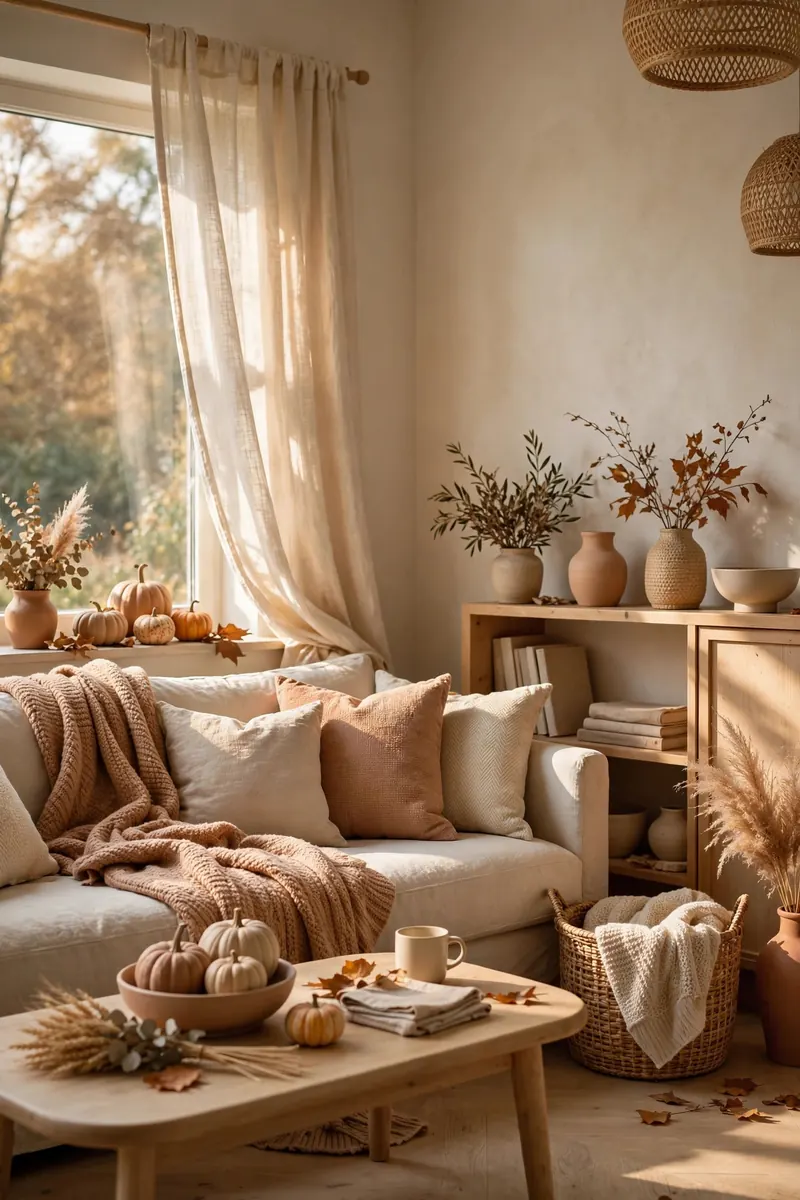
<!-- PINTEREST HERO IMAGE: Vertical 1000x1500 styled minimalist living room corner with small natural pine tree, warm white string lights, neutral linen throw, bold text overlay "Minimalist Christmas Decor Ideas" -->
The holiday look that actually feels like a holiday
Most Christmas decorating advice has the same hidden assumption: more. More trees, more garlands, more color, more novelty ornaments, more lights per square foot. The result is homes that look festive in a photo and feel exhausting in person — every surface busy, every room shouting, and January bringing a storage avalanche nobody looks forward to.
Minimalist Christmas decor flips the equation. It's not about being austere or joyless; it's about giving each decoration enough breathing room to be noticed. A single perfect wreath on a bare door. One tree, styled with intention, instead of three. Light that glows instead of blares. The calm comes from restraint, and the beauty comes from choosing well rather than choosing a lot.
What you'll find below: 13 concrete ideas covering the minimalist holiday philosophy, tree strategies (including the case for no tree), two-color palettes, single statement pieces, Scandinavian and Japandi touches, natural materials, calm lighting, the pre-decoration declutter, simplified gifting, and the post-holiday cleanup that makes next December easy. Every tip includes real specifics — dimensions, materials, rough costs — so you can actually do this, not just admire it.
> *Affiliate disclosure: Roomora is reader-supported. When you buy through links on this page, we may earn an affiliate commission at no extra cost to you.*
The minimalist holiday mindset
1. Declutter before you decorate — every single year
The biggest mistake in holiday decorating is treating it as pure addition: boxes come out of storage and get layered on top of everything already there. Minimalist decorating starts with subtraction. Before you touch a ornament, walk each room with a basket and remove the visual noise — the dead batteries, the expired coupons, the decorative objects you don't actually love. Our room-by-room decluttering guide is the fastest way to run this reset, and doing it in November means you start the season with clear surfaces instead of competing with them.
This one step does more for a calm holiday home than any purchase could. A mantel with three items looks styled; a mantel with twelve looks like a yard sale. When you give decorations clean surfaces to sit on, each one reads as intentional — which is exactly what minimalist Christmas is about. Plan on a single afternoon, room by room, and be honest about what stays out for December.
2. Commit to a two-color palette — and mean it
The fastest route to visual calm is a hard limit: your holiday decor uses two colors, period, plus whatever neutral base your home already has. White and pine green. Warm gold and cream. Charcoal and natural wood. Black and red if you want drama — the number is the discipline, not the specific colors. Write the two colors down before you buy anything, and let them act as a bouncer: anything in a third color doesn't come home with you.
This single rule prevents the most common minimalist failure mode — drift. You start with elegant neutrals, then add "just one" red ornament, then a plaid ribbon, then gold tinsel because it was on sale, and by December 20th the whole thing looks accidental. Two colors also simplify every future decision: gift wrap, table settings, and next year's purchases all inherit the palette. It's the difference between a collection and a jumble.
3. Set a decorating budget and let simplicity save you money
Minimalism is quietly the cheapest decorating style there is, and it pays to lean into that on purpose. Set a seasonal decorating budget before you shop — for many households, $75–150 covers an entire minimalist Christmas, because you're buying fewer, better things: one spool of good linen ribbon, a set of warm-white LED lights, a dozen matching ornaments, and that's nearly it. Compare that to the creeping $300–500 many households spend across novelty items, extra trees, and impulse sale-rack finds.
The savings compound over years. A restrained, classic palette (green and white, gold and cream) never goes out of style, so you stop re-buying "this year's look." Quality basics — glass or wood ornaments, real candles in hurricane holders, a good wreath — last a decade or more. And because everything fits in one or two storage bins, you skip the annual "rent another storage unit for the inflatable reindeer" tax entirely.
The tree, handled simply
4. Choose one tree and give it a job
The minimalist move is one tree — a single, deliberate focal point instead of a tree per room. Choose the room where your family actually gathers (usually the living room) and let the tree own that corner. For most spaces, a 6–7 ft tree with a slim profile works beautifully: it reads full without eating the room, and a slim tree's footprint (roughly 3–4 ft wide at the base) leaves walking space around it. A pre-lit slim artificial tree in this size typically runs $60–150 and is reusable for years, while a real tree of similar size runs $50–100 each season but brings unbeatable scent.
Decorating strategy for one tree: pick one ornament type and repeat it. A dozen identical matte balls. Twenty handmade paper stars. One ribbon, spiraled down. Restraint on a single tree looks rich; variety on a single tree looks cluttered. Skip the tree skirt complexity — a simple woven basket, a linen cloth, or even the tree's own stand is fine. If your home is small, a 3–4 ft tabletop tree on a sideboard or console gives you the full ritual (lights, ornaments, presents beneath) in two square feet — small Christmas tree ideas covers apartment-scale options in detail.
5. Consider the no-tree Christmas (seriously)
Here's a legitimate minimalist option few guides will admit: skip the tree. A large potted olive tree, fig tree, or Norfolk pine you already own — strung with one strand of warm-white lights and nothing else — reads beautifully and needs no storage in January. Alternatively, lean into architectural alternatives: a tall vase (24–30 inches) of bare branches decorated with five or six paper ornaments, or a wall-mounted triangle of wooden dowels with a single light strand for a tree "outline" that takes zero floor space.
The no-tree approach works best in homes where the tree feels like obligation rather than joy — small apartments, homes with curious toddlers or cats, or anyone whose December is already packed. You're not skipping Christmas; you're choosing which traditions earn their floor space. Most people who try one no-tree year and love it never go back.
6. Keep the tree area uncluttered, not barren
The square feet around the tree matter as much as the tree. Limit the "under the tree" zone to wrapped gifts and nothing else — no extra garlands, no overflow ornaments, no collection of shopping bags waiting to be wrapped. Presents themselves are decoration in a minimalist home, which makes wrapping aesthetics important (more on that in tip 12). One rule that helps: gifts live under the tree, never scattered around the room.
If you're working with a tight living room, check the tree's sightlines before you commit to a spot — you want it visible from the main seating, not blocking the path to the kitchen. A tree that forces everyone to squeeze past it breeds December resentment, not holiday spirit. Budget-friendly living room decor ideas has more on arranging a room around a single strong focal point without spending much.
One statement per room
7. Hang one great wreath and let it carry the entryway
A wreath is the highest-impact-per-square-inch holiday decoration that exists: one item, one hook, instantly festive. The minimalist version is full but simple — a fresh or faux greenery wreath (18–24 inches for a standard door) with no more than one accent: a linen bow, a few pinecones, or a single strand of berries. Anything beyond one accent is where wreaths start looking busy.
Placement matters as much as the wreath itself. One wreath on the front door does the work of ten porch decorations. Inside, a matching or coordinating wreath on a mirror or above the fireplace creates a thread through the home without multiplying clutter. And because the entryway sets the tone for the whole visit, keeping it to a single statement prevents the "Christmas exploded at the threshold" effect — our entryway organization ideas can help keep the rest of that space calm too.
8. Run one garland, not five
Garlands multiply fast — mantel, staircase, doorways, windows — and each additional one halves the calm. Pick the single best horizontal surface in your home (usually the mantel, a console table, or a long windowsill) and run one fresh or faux greenery garland there, roughly 6–9 feet depending on the surface. Style it the same way as your wreath: greenery plus exactly one accent, with a string of warm-white lights if you want evening glow.
The honest trade-off: real garlands smell incredible and cost $25–60 for a good fresh one, but they shed and need replacing each season. Faux garlands ($20–50 for a decent one) look convincing from a few feet away and store flat in a single bin. For a minimalist home, one good faux garland reused annually is the practical choice — it stays out of the landfill and out of your budget, year after year.
9. Style a simple holiday vignette on one surface
Instead of decorating every surface, build one small vignette — a composed little scene, 2–3 feet wide — on a single surface like a coffee table, sideboard, or windowsill. The formula: one natural element (a bowl of pinecones, a sprig vase of eucalyptus), one light source (pillar candles in glass hurricanes or a small cluster of battery-operated tea lights), and one seasonal accent (a small wooden deer, a stack of wrapped books, a sprig of berries). Three components, done.
Vignettes work because they're contained. The eye reads the whole composition as one deliberate gesture instead of scattered clutter. When January comes, one vignette takes four minutes to dismantle — compare that to un-decorating fourteen surfaces. If you need inspiration for styling a single surface well, gallery wall ideas covers the same composition principles for walls, and the discipline of "one arrangement, done well" transfers directly.
Materials and light
10. Build the look from natural materials
Scandinavian and Japandi holiday styling — the two aesthetics behind most "calm Christmas" inspiration — share one rule: natural materials first. Wood, linen, wool, paper, pinecones, fresh greenery, dried oranges, cinnamon sticks, beeswax candles. These materials have quiet, matte textures that never scream for attention, and they age gracefully instead of looking cheap by December 28th.
Practically, this means reaching for a wooden bead garland instead of plastic tinsel, paper star lanterns instead of glittery figurines, a linen table runner instead of a themed one. The trade-off is honest: natural materials are sometimes less durable than plastic (paper ornaments tear, fresh greenery dries out), but they're also cheaper, often compostable, and they photograph beautifully. A bowl of pinecones you gathered yourself beats a bag of glittery baubles in every home it sits in. Dried orange slices — sliced ¼-inch thick, baked at 200°F for 2–3 hours — make ornaments and garlands that smell wonderful and cost essentially nothing.
11. Light for glow, not glare
Holiday lighting makes or breaks the calm. The minimalist rule: warm white (2700K) lights only, and fewer strands than you think. One strand of 100 micro-LED lights on a 6-ft tree is enough; three strands is where trees start looking like they're trying to signal aircraft. Micro or fairy lights on thin wire disappear into branches and garlands, giving you glow without visible hardware.
Layer the light sources rather than adding more bulbs: the tree lights, one strand along your single garland, and candles (real or battery-operated with a timer) for the vignette. Then — and this matters more than any product — turn off the overhead lights in the evenings. A minimalist Christmas at night should be mostly candlelight and tree glow; overhead lighting kills the mood that the whole style depends on. Battery-operated pillar candles with timers ($15–30 for a set of three) are the low-maintenance answer — they click on at dusk, off at bedtime, no fire risk, no wax.
The practical finish
12. Make gifting part of the aesthetic
In a minimalist home, wrapped presents under the tree are decoration, so wrap them like it. The simplest elegant system: one paper (plain kraft, matte white, or a single solid color matching your two-color palette), one ribbon (linen or cotton twill, 1–1.5 inches wide), and one natural sprig tucked under the bow — rosemary, eucalyptus, or a tiny pine cutting. Buy the paper in bulk rolls (a 100-ft roll of kraft is typically under $15) and the look stays consistent across every gift.
This approach also simplifies the logistics. One paper and one ribbon means no sorting through six half-used rolls, no clashing patterns, no last-minute store runs for "matching" paper. A small, dedicated wrapping setup — even just a basket with paper, ribbon, tape, and tags — keeps the whole operation contained; gift-wrapping station ideas covers compact versions that fit in a closet. And if you're gifting experiences or consumables (tickets, homemade food, a donation), the wrapping stays just as simple — a plain box, the same ribbon, done.
13. Plan storage and January cleanup before you decorate
Minimalist Christmas has a secret superpower: takedown takes an hour, not a weekend. Plan for it now, in October, before a single box comes out. One or two clear, stackable bins (look for 27-gallon latch-lid totes, roughly $12–18 each) hold an entire minimalist holiday: ornaments nested in the original packaging or divided trays, the garland coiled in a bag, lights wound around a piece of cardboard, ribbon and tags in a zip bag on top.
Label the bins by contents ("Tree ornaments — white/gold," "Garland + lights") and store them somewhere reachable — a closet shelf, under a bed, the top of a wardrobe — so December setup is equally fast. Holiday decor storage ideas goes deep on systems if you want to get serious about it. The deeper point: when cleanup is this easy, you're more likely to decorate next year. Complicated holidays burn people out; simple ones become traditions.
Frequently asked questions
How do I decorate for Christmas in a minimalist style without it looking bare?
Bare and minimalist are different things, and the difference is intention. Bare looks like you forgot; minimalist looks like you chose. The line is in the details: full greenery (a lush wreath, a real tree), warm layered lighting, and natural textures (linen, wood, wool) signal care even when the item count is low. One rich, full wreath reads as abundant — it's the thin, sparse dollar-store version that reads as empty. Invest in fullness of the few pieces you choose rather than quantity of pieces.
What colors work best for minimalist Christmas decor?
Two-color combinations built on a neutral base: white and pine green is the classic, warm gold and cream feels luxurious, charcoal and natural wood leans modern, and deep red with natural wood is the Scandinavian traditional look. The specific colors matter less than the discipline of the number. If your year-round home is already neutral (white, beige, gray walls and furniture), almost any two-color pairing will sit calmly in it — the base does the heavy lifting.
Can I still have a big tree if I want a minimalist Christmas?
Yes — minimalism is about restraint, not size. A large tree decorated with one ornament type and warm-white lights is absolutely minimalist; a small tree covered in fifty mismatched ornaments is not. The principles scale: one tree, a limited palette, repeated elements, clear space around it. If you love a grand tree, give it the minimalist treatment and let its scale be the statement instead of adding more statements around it.
How do I keep kids' Christmas clutter from ruining the minimalist look?
Give the kids' chaos a container — literally. Designate one zone (their bedroom, a play corner) where school crafts, bright ornaments, and the glittery gifts from relatives live freely, and keep the shared living spaces to the adult aesthetic. Let kids decorate their own small tree (a 3–4 ft tabletop tree is perfect for this) with full creative freedom. Most kids care more about having their own thing than about covering every surface of the house. And honestly, a few handmade paper chains on the kids' tree usually charm guests more than a perfectly styled one.
Is minimalist Christmas decor actually cheaper?
Almost always, yes — but only if you resist the minimalist-industrial complex selling you $40 "simple" ornaments. The style saves money through fewer items, a stable palette you don't re-buy yearly, and reusable natural or faux basics. A full minimalist setup can run $75–150 and last a decade. Where people lose the savings is buying premium versions of simple things; a pinecone is free whether it's from a forest or a boutique, so choose the forest.
When should I take down minimalist Christmas decorations?
Whenever you want — the cleanup is an hour, so there's no dread. Many people take everything down the first weekend of January; others keep the greenery and lights (minus the explicitly Christmas ornaments) through January for winter coziness, which works well with the natural-materials aesthetic. One practical tip: schedule takedown before you feel like it. The decorations stop feeling festive the moment they start feeling like a chore to remove.
Keep going
If you're easing into the season, start with fall home decor and organization ideas to transition your home gradually rather than flipping a switch on December 1st. For the centerpiece itself, small Christmas tree ideas go deep on apartment-scale trees, and when January arrives, holiday decor storage ideas will help you pack it all away in a single afternoon. And if the gift side of the season is your stress point, gift-wrapping station ideas keeps the wrapping operation contained and calm.
Get the Sunday reset: one practical home idea in your inbox every week — subscribe free here. No spam, ever.
Pin title ideas
- 13 Minimalist Christmas Decor Ideas for a Calm Holiday Home
- Minimalist Christmas: How to Decorate Beautifully with Less
- The Two-Color Rule for a Serene, Stylish Christmas
- Scandinavian Christmas Decor Ideas (Natural & Calm)
- Minimalist Holiday Decorating That Actually Saves Money